Neighborhood
How to Build Real Estate City & Market Pages That Actually Rank
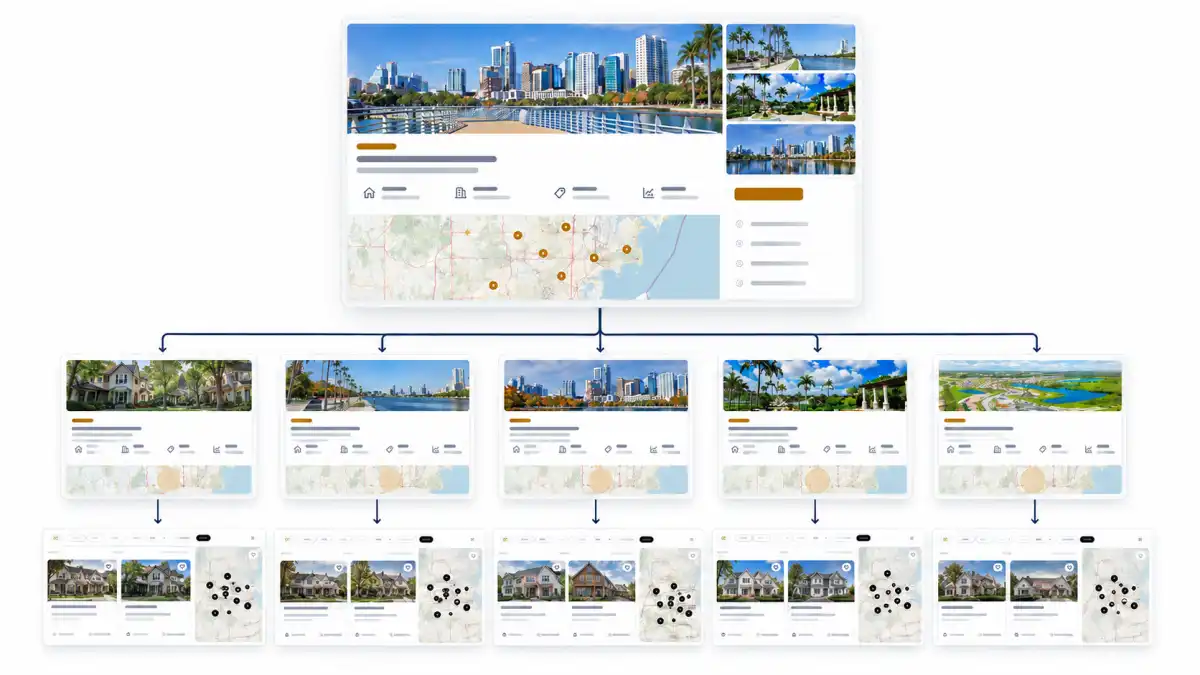
What a city page does that a neighbourhood page can’t: orientation, market context, a community map and a crawl path — without cannibalising the pages beneath.
Introduction
City pages are the level of a real estate site most likely to be either missing or wrong.
Missing, because agents jump straight to neighbourhood pages — the tactic everyone recommends — and never build the level above them. Wrong, because when they do build it, they write an oversized neighbourhood page: same structure, bigger area, and now two pages on the same site competing for overlapping terms.
This article is about the specific job a city page does, and why that job is different in kind rather than in scale.
⚡ Quick answer — what should a city page do? Orient someone who has not yet chosen a neighbourhood. It answers "what is this market like, what does it cost, and which parts of it should I be looking at" — then sends them down to the community pages that answer "what is this part like". Its most important structural job is being the crawl path to those pages. If your city page reads like a long neighbourhood page, it is competing with its own children.
The hierarchy
Three levels, each with a distinct question and a distinct reader.
Market or city — "Where should I look?" Someone relocating, or a local who has not narrowed down. They do not yet know the names of your communities.
Community or neighbourhood — "What is it like here?" Someone who has narrowed to one or a few areas and wants what only presence reveals.
Property — "Should I see this one?" A specific home.
Each level answers a question the others cannot, which is what keeps them from competing. The moment two levels answer the same question, you have a cannibalisation problem — and the usual cause is a city page trying to be a very large neighbourhood page.
Terminology varies by region: "market", "city", "community", "area" and "district" mean different things in different places. Community vs neighbourhood vs area pages works through that. What matters here is the levels, not the labels.
What a city page contains
- 1
Orientation
What this market is, in a paragraph someone relocating could use
vs the area page — Neighbourhood pages assume you already chose the city
- 2
Market context
Price direction, inventory, days on market — city-wide, sourced and dated
vs the area page — The one block where city-level data is genuinely more reliable than area-level
- 3
The map of the market
Which communities exist, how they relate, roughly what each is known for
vs the area page — This is the page's main job. Neighbourhood pages cannot do it
- 4
Links down to areas
Every community page you have built, as a real navigational block
vs the area page — The crawl path to your area pages. Without it they are orphans
- 5
Inventory, city-wide
Current listings across the market, rendered in the page
vs the area page — Broad rather than boundary-drawn — that precision belongs one level down
- 6
Getting around
Transit spine, highways, commute realities at city scale
vs the area page — Neighbourhood pages give the door-to-door version
- 7
Buying and selling here
Local process, taxes, timing, anything jurisdiction-specific
vs the area page — Applies to the whole market, so it would be repetition on every area page
The failure this prevents: a city page written as an oversized neighbourhood page, competing with its own children for the same terms.
Three of these deserve expanding.
The map of the market is the main job
If a city page has one irreplaceable function, this is it: explaining which communities exist, how they relate to each other, and roughly what distinguishes them.
Nobody else does this well. Portals list areas alphabetically. Municipal sites use administrative boundaries nobody recognises. What a buyer actually wants is the thing a local would say over coffee — the east side is older housing stock and closer to transit, the north is newer and family-heavy, this pocket trades at a premium and here is why.
That is genuinely hard to write and impossible to generate, which is exactly why it is worth writing.
It also does the structural work: it is the natural, contextual place to link down to every community page you have built.
Market context is the one block where city-level data is better
At neighbourhood scale, median price and days on market are often computed from small samples and swing wildly. At city scale the sample is large enough to mean something.
So the city page is where market statistics genuinely belong — and where the discipline still applies: every figure carries a source and a date. A median price with no date is a liability the day after you publish it.
This is also the block that ages fastest, which makes it the natural anchor for a refresh cadence.
Inventory belongs, but broadly
City-wide listings, rendered in your own page rather than an iframe. Content inside a third-party frame does not belong to your page as far as search engines are concerned.
The precision — inventory matched to a drawn boundary — belongs one level down. At city level, breadth is the point.
How not to cannibalise your neighbourhood pages
The failure mode worth naming precisely.
The symptom: your city page and your best neighbourhood page both target overlapping terms, and Google alternates between them, ranking neither well.
The cause: the city page was written with the same template as the area pages, just covering more ground. It has presence detail, boundary discussion, hyper-local specifics — everything the area page has, one level up.
The fix, in three rules:
- The city page answers "which area?" The area page answers "what is this area like?" If your city page contains a paragraph about what a specific street is like on a Tuesday morning, that paragraph belongs on the area page.
- Depth goes down, breadth stays up. Anything true of only part of the city is a signal it belongs lower.
- Link explicitly and often. A city page that names its communities and links to each is telling search engines the relationship. One that discusses them without linking is competing with them.
A useful check: if you deleted the area pages, would the city page still make sense? It should. If you deleted the city page, would the area pages be discoverable? Usually not — which tells you which one is structural.
Search intent
City-level real estate queries split into three groups, and only two are worth chasing.
"Homes for sale in [city]" — high volume, dominated by portals, and the query where your inventory block matters most. Realistically you compete here on being a better local answer rather than a bigger index.
"Living in [city]" / "moving to [city]" / "[city] neighbourhoods" — lower volume, much higher intent, and where an agent can genuinely outperform. Someone asking which neighbourhoods to consider is early, undecided and worth far more than a listing browser. This is the underserved group.
"[city] real estate market" / "house prices in [city]" — served by your market context block, and the query where a sourced, dated figure beats an undated one.
The second group is the argument for building the page at all. Portals win the first. Nobody owns the second.
Internal linking
City pages are the hub of the geographic structure, and the linking is the point.
Down: to every community page beneath, contextually, inside the map-of-the-market section. This is the crawl path — without it your area pages are orphans reachable only from a sitemap.
Up: to a region or market page if you have one. Breadcrumbs handle this and give you clean structured data.
Sideways: to adjacent cities, if you serve them. Someone comparing two suburbs is a real reader.
From everywhere: the city page should be reachable from your main navigation. It is a top-level entity, not a leaf.
How many city pages?
Far fewer than neighbourhood pages, and the constraint is different.
Build a city page for a market where you actually transact and can describe the communities from knowledge. That last clause is the binding one: the map-of-the-market section is the page's reason to exist, and you cannot write it for a city you do not know.
Two or three markets is normal for an agent. A brokerage with offices in several cities can justify more. Twenty cities because they are within driving distance is the doorway-page problem at a larger scale — see how many neighbourhood pages, where the same reasoning applies.
Maintenance
City pages age differently from area pages, and in a helpful way.
Ages fast: the market statistics. Quarterly if you quote them, and a stale figure is worse than none.
Ages slowly: the map of the market. Community character shifts over years, not months.
Maintains itself: the inventory block.
So the cadence is: refresh figures on a schedule you can keep, revisit the written content when something structurally changes — a transit line opens, a major development completes, a boundary shifts in common usage.
FAQ
Do I need a city page if I have neighbourhood pages? Yes, and it is usually the higher priority. Without it your area pages have no crawl path and no hub, and you are absent from the "which neighbourhood?" queries entirely.
What if my city page competes with a filtered search URL? Fix the filter URLs, not the page. Canonicalise them so combinations do not compete — see technical SEO.
How long should a city page be? Long enough for the map of the market, which is usually the longest section. Length is not the ranking factor; whether you could have written it about another city is.
Should I use the municipal boundary? For the page's scope, usually yes — people search by municipality. For the communities inside it, use the names residents use, which frequently cross administrative lines.
Can I use market statistics from my board? Check your data licence. Aggregate market statistics are often permitted where individual listing data is constrained, but the terms vary — see IDX compliance.
What about a page for the whole region? Only if you genuinely serve it and can say something region-specific. Otherwise it becomes a link hub with no content of its own.
In short
A city page orients someone who has not yet chosen a neighbourhood, gives market-wide context that is more reliable at this scale than below it, and maps the communities in a way nobody else bothers to.
Structurally it is the hub: the crawl path to every area page you build. Written wrong — as a bigger neighbourhood page — it competes with its own children. Written right, it is the page that captures the reader who has not decided yet, which is the most valuable reader on the site.
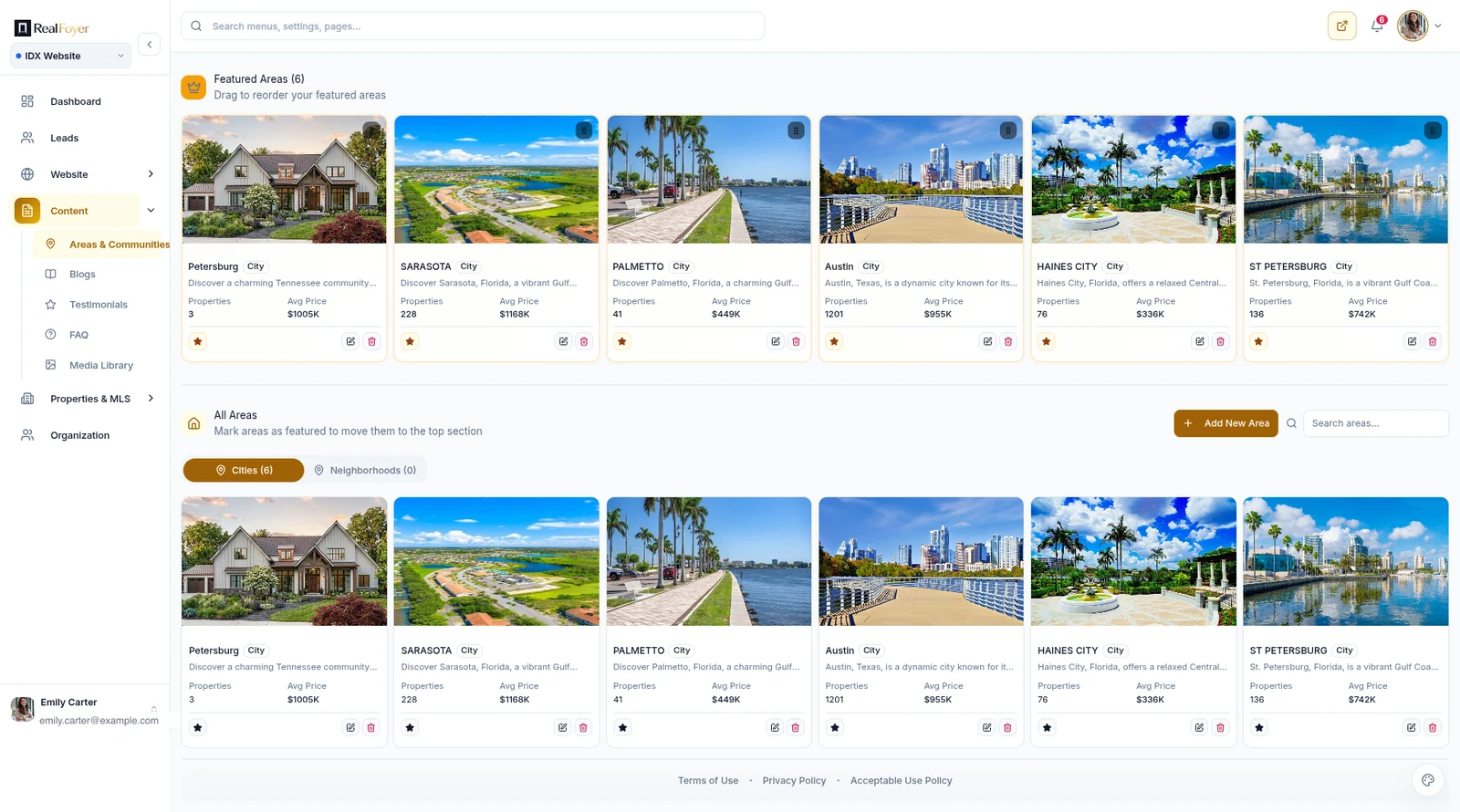
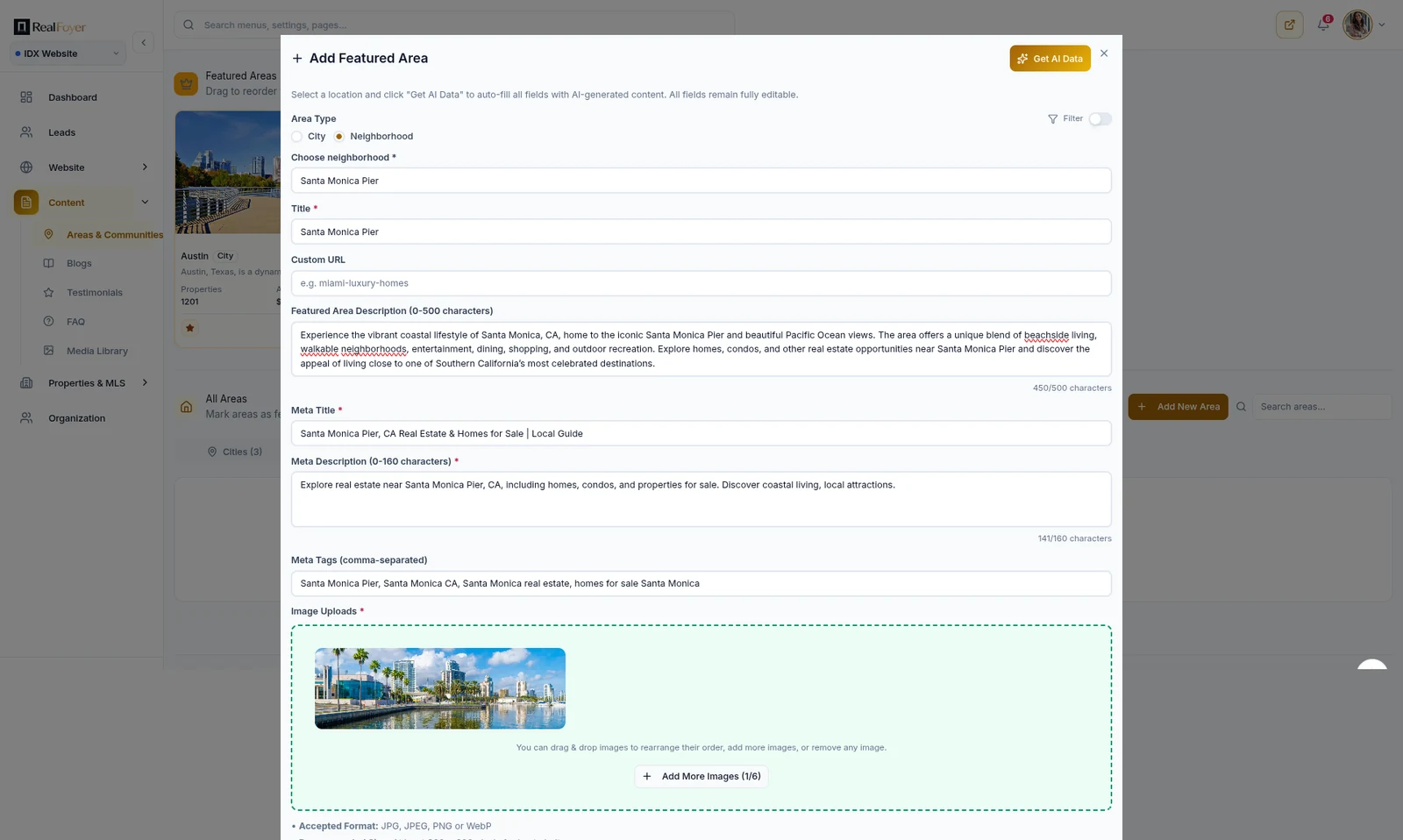
Explore RealFoyer IDX websites — city and area pages with their own metadata, plus inventory rendered in the page rather than an iframe.
Related reading
- Neighborhood Pages That Actually Rank
- Community vs Neighborhood vs Area Pages
- How Many Neighborhood Pages Should a Website Have?
- Real Estate SEO: The Complete Guide
- Technical SEO for Real Estate Websites
Research Integrity
Published 16 August 2026. This article was written to occupy the level above neighborhood-pages-guide without repeating it: the cannibalisation section states the distinction explicitly, and the diagram annotates every block with how it differs from the area page equivalent. No statistics about city-page performance or search volume are cited — the query groupings are described qualitatively by intent rather than by volume, because no traceable source supports specific figures. The observation that market statistics are more reliable at city scale than neighbourhood scale is a property of sample size, stated as reasoning rather than as a cited finding. Guidance on using board market statistics deliberately directs readers to their own data licence, because terms vary by board.