Neighborhood
Community vs Neighborhood vs Area Pages: Which Should You Build?
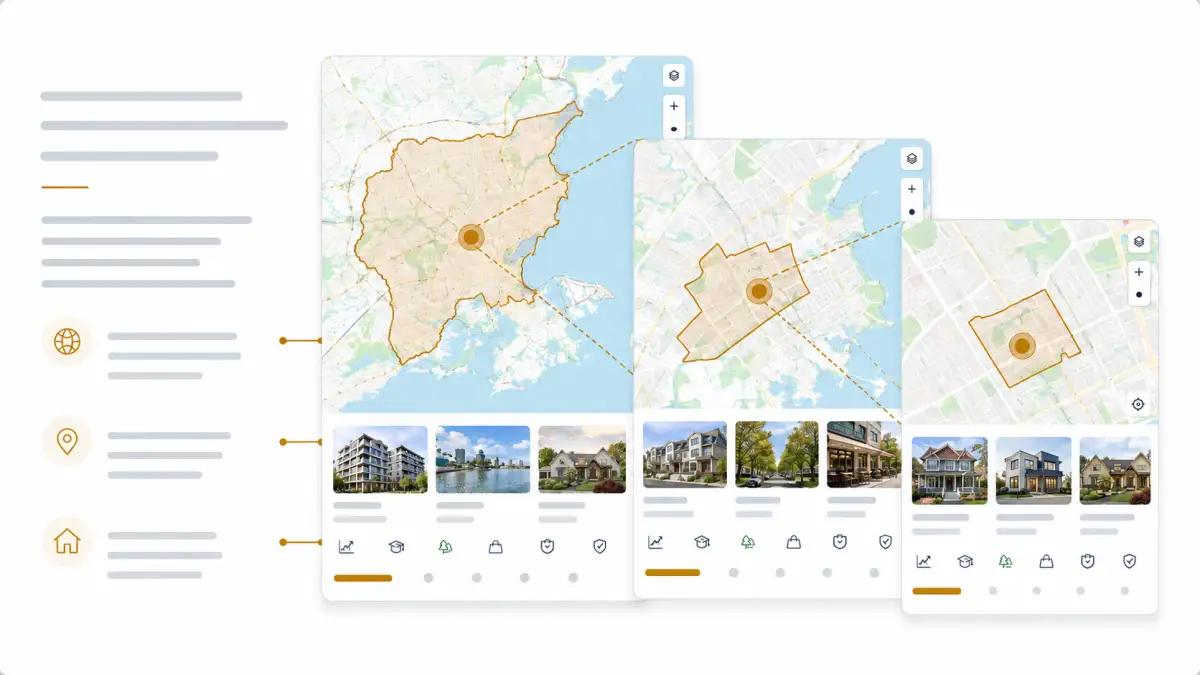
The geographic page levels on a real estate site, sorted by the question each answers rather than by labels that mean different things in different markets.
Introduction
"Community page", "neighbourhood page", "area page", "district page" — these terms get used interchangeably in real estate SEO advice, and they do not mean the same thing. Worse, they do not mean the same thing in different places: a "community" in a Calgary context is not what a "community" means in Toronto, and neither matches how a US brokerage would use the word.
That makes "should I build community pages or neighbourhood pages?" an unanswerable question as asked. This article reframes it into one that can be answered.
⚡ Quick answer — which geographic page type should I build? Stop sorting by label and sort by the question the reader is asking. There are really only two levels most agents should build: the market level (which part of this city?) and the specific-place level (what is it like here?). Everything else is either a naming variation on those two, or a level you should skip. Whatever your market calls them, build one page per question — never two pages answering the same one.
The vocabulary problem
A quick tour of how inconsistent this is:
- In Calgary, "community" is the official municipal term for what elsewhere would be called a neighbourhood, and residents genuinely use it.
- In Toronto, "neighbourhood" is the common term, and the City's own list of 158 differs from what residents recognise.
- In much of the US, "subdivision" carries meaning that "neighbourhood" does not, especially in newer suburban markets.
- "Area" is the vaguest of all, used at almost every scale.
- "District" usually implies something administrative or commercial.
None of these is wrong. They are local conventions, and the correct choice is whatever your market's buyers actually type and say.
The practical rule: use your market's vocabulary in the page's language, and think about levels in your own head. The taxonomy is for your information architecture; the words are for your readers.
Sort by question, not by label
Which market should I be in at all?
Often called — Region · Metro · Market
Relocating from elsewhere, or comparing two metros
Build it? Only if you genuinely serve the whole region and can say something region-specific
Which part of this market suits me?
Often called — City · Town · Market
Has chosen the metro, not the neighbourhood
Build it? Yes — for every market you actually transact in. This is the hub
What is it like to live in this part?
Often called — Community · District · Quadrant
Narrowing between a few named parts of a city
Build it? Only where the name is one residents actually use
What is this specific place like?
Often called — Neighbourhood · Area · Subdivision
Close to deciding, wants what only presence reveals
Build it? Yes — for areas you know well enough to write from experience
Should I see this home?
Often called — Property · Listing
Evaluating one address
Build it? Generated from listing data
The levels are stable; the vocabulary is local. Match the words your market actually uses, and let each page answer a question the others cannot.
The questions are stable across every market. The labels are not. So the questions are the useful organising principle.
Two of these five levels are where nearly all the value is.
The two levels almost everyone should build
The market level — "which part of this city?"
One page per market you actually transact in. Its job is orientation and it is the hub that links down to everything below.
This is the most commonly missing level, and its absence is expensive: without it your specific-place pages have no crawl path, and you are invisible to the reader who has not yet chosen an area.
City and market pages covers this level in full.
The specific-place level — "what is it like here?"
One page per place you know well enough to write from experience. This is the level that outranks portals, because it is the only one where presence produces something a database cannot.
Neighbourhood pages that actually rank covers this level in full.
The three levels to be careful with
Region or metro — usually skip
A page covering "the Greater Toronto Area" or "the Bay Area" tends to become a link hub with no content of its own, because almost nothing is true of the whole region and specific to it.
Build one only if you genuinely serve the whole region and can say something region-specific — relocation guidance, cross-market comparison, regional transit or tax context that applies throughout.
Skip it if the page would just be an index of your city pages. Your navigation already does that.
The intermediate level — sometimes
Some markets have a real intermediate tier: a named collection of neighbourhoods residents recognise as a unit. "The Beaches" in Toronto, "the West End" in many cities, a named quadrant.
Build one if the name is genuinely in use — people say "we're looking in the west end" as a first pass before narrowing — and you can say something true of the whole of it.
Skip it if you invented the grouping for SEO. A page about "Central Oakville" that no resident would use is a page nobody searches for, and it sits awkwardly between two levels that are both more useful.
The test: would a resident say this name unprompted when asked where they live or where they are looking? If not, skip.
Property pages — generated, not written
Driven by listing data. Worth mentioning only because they are part of the hierarchy and because their canonicalisation is the most common technical problem on IDX sites — see technical SEO.
The rule that prevents all the problems
One page per question. Never two pages answering the same reader question.
Almost every problem in this area reduces to a violation of that rule:
- A city page written like a big neighbourhood page — two pages answering "what is it like here?"
- A "community" page and a "neighbourhood" page for the same place, created because two different terms seemed like two different opportunities — two pages, one question, and neither ranks.
- An intermediate page invented for keyword coverage — a page answering a question nobody asked.
When you find two pages competing, the fix is usually not to differentiate the keywords. It is to work out which question each should answer, rewrite one to answer it, and link them.
Choosing your labels
Once you know your levels, pick the words:
Use what your market uses. If Calgary buyers say "community", say community. Matching the vocabulary is worth more than internal consistency with an SEO taxonomy.
Be consistent within your site. Pick one term per level and use it in headings, breadcrumbs and navigation. Mixing "area" and "neighbourhood" for the same level makes the structure harder to read for both people and machines.
Match your URLs to your levels, not to your labels: /toronto/ and /toronto/leslieville/ expresses the hierarchy regardless of what you call each level in prose.
Do not create a second page to capture a synonym. If people search both "Leslieville neighbourhood" and "Leslieville area", that is one page. Use both words naturally in the copy.
FAQ
Should I build both community and neighbourhood pages? Only if they answer different questions in your market. If "community" and "neighbourhood" describe the same scope where you work, that is one level and one page.
What if my city has official neighbourhood boundaries? Useful as a reference and rarely a good basis for pages. Official lists frequently include names residents do not use and split areas people experience as one. Build on the names people say.
How do I handle areas that cross city lines? Pick the level that matches how people search — usually the specific-place name — and mention which municipalities it spans. Overlap is normal.
Do I need a region page for SEO? Almost never. It is the level most likely to become thin.
What about condo buildings or subdivisions? In condo-dense markets a building page can be a legitimate specific-place page, if you have inventory and real knowledge of it. The same test applies: could this be about any building?
Can I rename my page types later? The labels, yes, cheaply. The URLs, more carefully — changing structure means redirects. Get the hierarchy right early even if the words change.
In short
The labels are local and inconsistent; the questions are not. Sort your pages by the question each answers, use whatever words your market actually uses, and hold one rule above the rest: one page per question.
For most agents that means two levels — a market page that orients and links down, and specific-place pages that contain what only presence reveals. The rest is either a naming variation on those two or a level worth skipping.
Related reading
- Real Estate City & Market Pages
- Neighborhood Pages That Actually Rank
- How Many Neighborhood Pages Should a Website Have?
- Real Estate SEO: The Complete Guide
Research Integrity
Published 16 August 2026. The regional vocabulary examples — Calgary's use of "community" as the municipal term, Toronto's neighbourhood naming, and "subdivision" in US suburban markets — are given as illustrations of inconsistency rather than as authoritative definitions, which is the article's actual argument: no universal taxonomy exists and imposing one would be wrong. The Toronto figure of 158 official neighbourhoods reflects the City's own published list; it is included to make the point that official lists and resident usage diverge, not as a recommendation to build from either. No search-volume or performance statistics are cited. No product claim appears; the article is structural guidance and no RealFoyer capability is relevant to it.