Neighborhood
Neighborhood Pages That Actually Rank
How to build neighbourhood pages that outrank portals — real boundaries, presence detail, listing inventory and market context — without thin or doorway pages.
Introduction
Neighbourhood pages are the most recommended tactic in real estate SEO and the most commonly botched. The advice — "build a page for every neighbourhood you serve" — is right about the opportunity and silent about the two things that decide whether it works: where the boundaries actually are, and whether you have anything to say once you have drawn them.
Done well, these pages are the one place an independent agent reliably outranks a portal. Done as a template with a place name swapped in, they are a liability that can drag on the rest of the site.
⚡ Quick answer — What makes a neighbourhood page rank? Content that required presence to write. Portals can generate an area page from a database, so listing counts and median prices are not differentiators. What ranks is boundary accuracy, specifics only a local would know, current inventory for that actual area, and market context with a source and date. If the page could have been written from another city, it will perform like it was.
The postcode trap
The first decision is the one most sites get wrong, because it is made by whoever built the site rather than by anyone who works the area.
Postcodes are not neighbourhoods. They are mail-routing boundaries, and they routinely split a community in half or bundle three unrelated ones together. Build your pages on them and you produce pages describing areas that do not exist as anyone experiences them — with inventory that does not match the description, because the listings pulled are the ones inside a delivery boundary rather than the ones a resident would call local.
Real boundaries come from how people actually talk about where they live. Ask five residents where the neighbourhood ends and you will get a consistent answer with fuzzy edges — and that consistent answer is the page you should build, even where it fits no administrative shape.
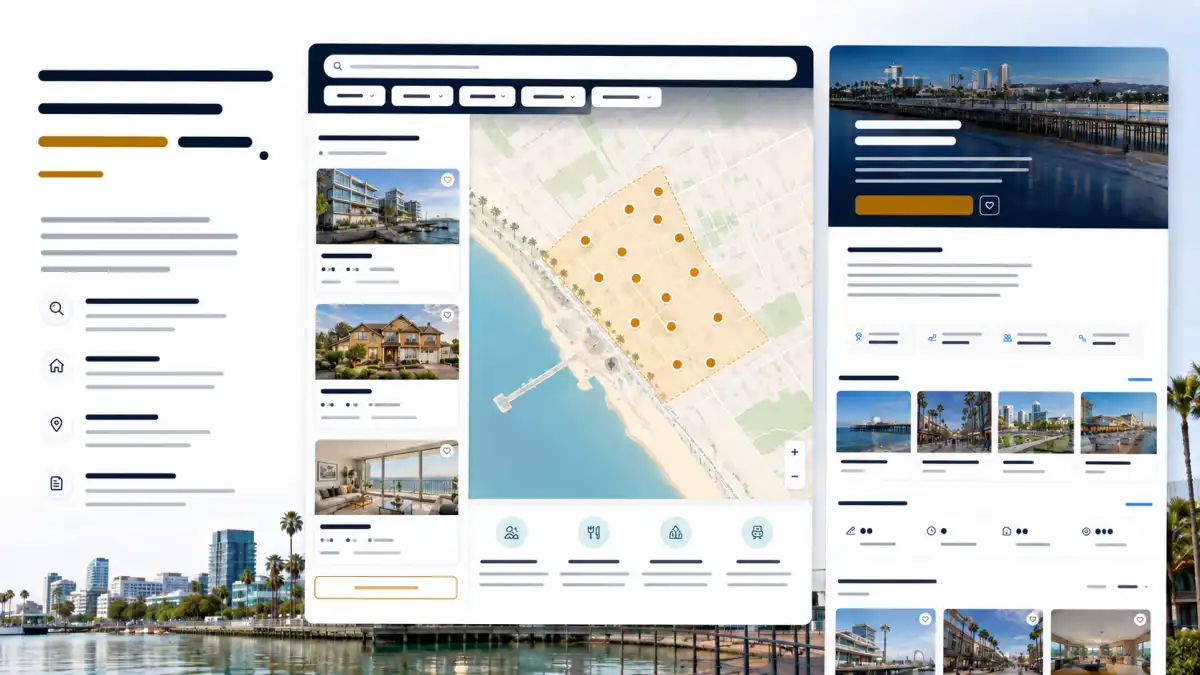
The practical consequence is that your listing block needs to be driven by a drawn boundary rather than a postcode filter. If your platform can only filter by postcode, your area pages will always describe one thing and list another.
When a neighbourhood page becomes a doorway page
There is a real line here, and it is worth stating precisely because the usual advice is vague.
A doorway page is one created primarily to capture search traffic for a variation, funnelling users to the same destination without offering distinct value. The mass-generated area page — same paragraphs, place name substituted, listing count injected — meets that description whether or not anyone intended it to.
The distinction is not length and it is not whether you used a template for the layout. It is whether the page contains something specific to that place. A 400-word page with three facts nobody else has is a real page. A 1,200-word page assembled from adjectives is not, however carefully it is written.
The test I would apply before publishing: remove the place name from the page. Could it be about anywhere else? If yes, it is not ready.
Fair housing is the constraint, not a footnote
This is where neighbourhood content differs from every other kind of SEO writing, and it deserves to sit near the top rather than in a compliance appendix.
Describing an area inevitably brushes against describing who lives there. Language characterising a neighbourhood by the people in it — or using proxies that amount to the same thing — creates real exposure, and it is easy to do accidentally while trying to be helpful.
The safe pattern is to describe the place, not the population. Housing stock, era, architecture, amenities, transit, what is being built. Not who it "suits", not what kind of family it is "perfect for", not characterisations of the community's composition.
Two specific traps:
Schools as a proxy. School information is legitimately useful and legitimately expected. Presented as a quality ranking that implies who should live somewhere, it becomes something else. Name the schools, cite the source, date the information, and let readers draw conclusions.
Community groups as source material. They are the best source of resident questions and full of exactly the characterisations to avoid. Read them for questions, not for descriptions — importing the latter makes you the publisher of them.
Requirements vary by jurisdiction and this is not legal advice. If you publish area content at scale, have someone qualified review your template language once.
What buyers actually weigh
Useful area content tends to answer questions in this order:
- What is it like to be here? The texture of the place — what the street is like on a weekday morning.
- What can I buy, and for what? Housing stock and current price reality, not last year's median.
- How do I get out of here? Commute, transit, the drive at the hour people actually drive it.
- What is changing? New construction, planned transit, a rezoning. Nobody else publishes this.
- What is here? Amenities, named and described factually.
Most templated pages answer only the second and fifth, which is why they read as brochures.
What a neighbourhood page contains
- 1
Orientation
Job — Where this is and what it borders
Risk — Boundary claims residents dispute
- 2
Presence detail
Job — What only visiting reveals
Risk — None — this is the part nobody can copy
- 3
Housing stock
Job — What is here, by type and era
Risk — Drifting into who lives in it
- 4
Market context
Job — Prices and inventory, with source and date
Risk — Going stale silently
- 5
Schools & amenities
Job — Named, sourced, dated
Risk — Becoming a proxy for protected characteristics
- 6
Getting around
Job — Travel times with the conditions stated
Risk — Off-peak figures presented as typical
- 7
Current listings
Job — Live inventory for this boundary
Risk — Iframed away from the page's own content
- 8
Next step
Job — A CTA specific to this area
Risk — Becoming the page's only purpose
Every block is optional except the second. A page without presence detail is a template with a place name in it.
Presence detail is the whole moat
Everything else on the page can be assembled from data. This cannot.
What the street is like at 8:10 on a Tuesday. Which building completed last spring and what it did to inventory. Which corner floods. What residents complained about at the last council meeting. Why the east side trades at a premium to the west despite looking identical on a map.
None of it is available to someone writing from another city, and all of it is available to you for the cost of paying attention.
Commute times, stated honestly
Map APIs return off-peak estimates by default. Publish that number and you have published a figure describing a road nobody uses at that hour.
State the conditions with the number. "22 minutes at 8:10am on a weekday; 14 minutes off-peak" is useful. "22 minutes to downtown" is a number of unknown provenance, and residents will know it is wrong.
Market context needs a source and a date
Any figure on the page — median price, days on market, inventory — should carry where it came from and when. It is a credibility signal, and it is the only thing that stops the page silently rotting. A market figure without a date is a liability the day after you publish it.
Listings, rendered in the page
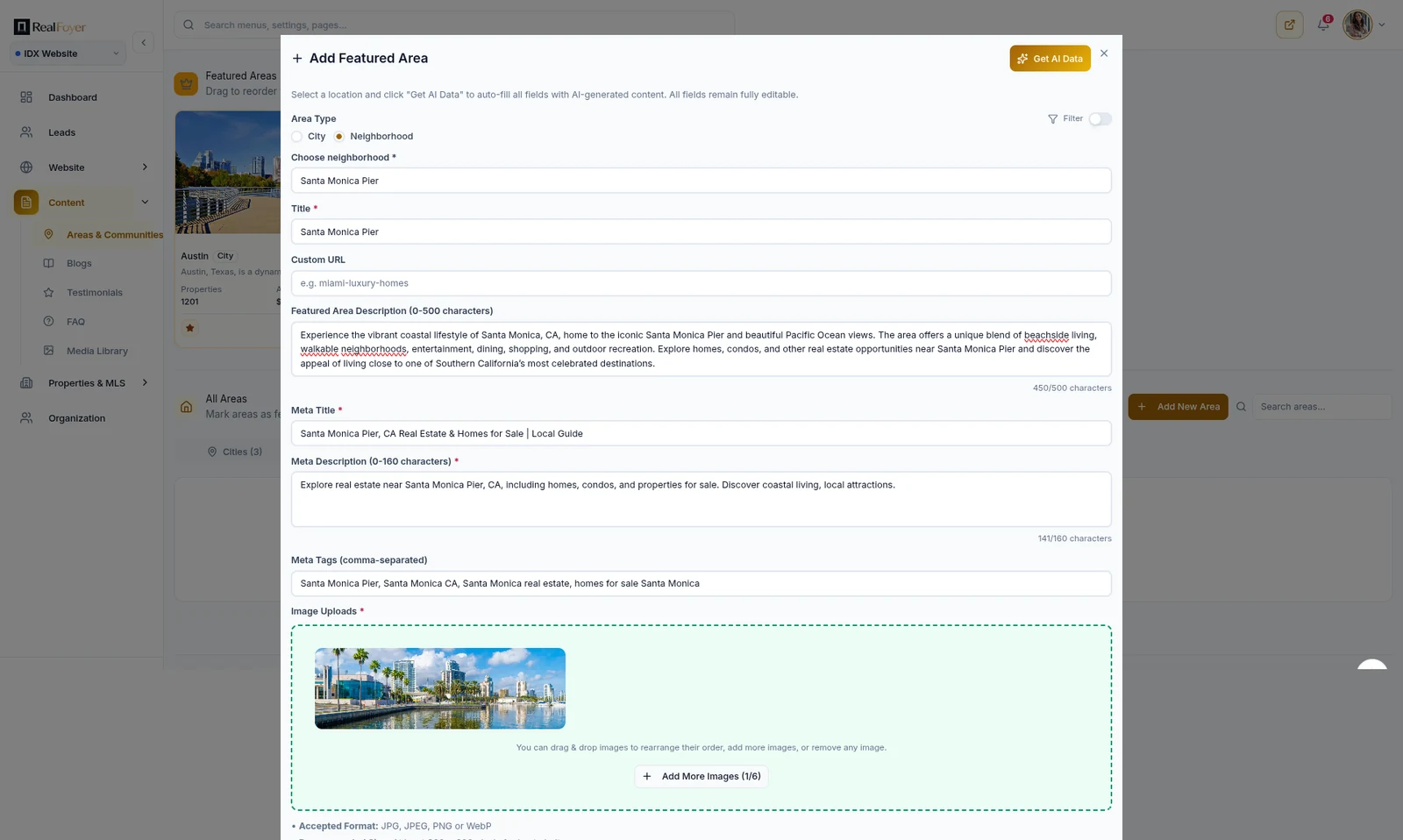
Current inventory for the actual boundary, in the page's own markup rather than an iframe. Content inside a third-party frame does not belong to your page as far as search engines are concerned, and it is one of the more common reasons an otherwise good area page underperforms.
Internal linking
Area pages are only as discoverable as the links pointing at them. Three habits:
Link from the city page down. If you have a Toronto page, it should link to every community page you have built beneath it. That is the crawl path.
Link sideways between adjacent areas. Someone reading about one neighbourhood is often comparing it to the one next door. Contextual, in a sentence, not a list.
Link back up. Every community page should point at its city page, ideally through breadcrumbs, which also gives you clean structured data.
What not to do: a footer block of forty neighbourhood links on every page. It carries almost no context and looks exactly like what it is.
For how the levels fit together, see Real Estate SEO: The Complete Guide. For the indexation mechanics — crawl paths, canonicals and why filter URLs eat crawl budget — see Technical SEO for Real Estate Websites.
Structured data
Breadcrumb markup is worth adding to every area page: it is well supported and reflects a hierarchy you already have.
Beyond that, be conservative. Marking up an area page as a place or organisation it is not can misrepresent what the page is, and rich result support for area content is inconsistent. Structured data helps machines understand a page; it does not make a thin page rank.
Refreshing, and page decay
Area pages decay in a specific way. The presence detail stays true for years. The market figures go stale in a quarter. The listing block updates itself.
That suggests the maintenance pattern: leave the writing alone, refresh the numbers on a schedule you can actually keep, and revisit the page properly when something changes in the area — a building completes, transit opens, a catchment moves. Those are also the moments the page becomes newly relevant.
A page nobody has touched in three years with a 2023 median price on it is worse than one that never quoted a figure.
Where to start
Not with a list of every area you serve.
Pick the one you know best — the one where you could talk for twenty minutes without preparation. Write that page properly, with real boundaries, real presence detail and dated figures. Publish it, link to it from the city page, and see what it does over a few months.
Then do the next one. A dozen pages built this way will outperform two hundred generated ones, and they will not put the rest of your site at risk.
Getting the listing block to follow a drawn boundary rather than a postcode is the part that usually depends on your platform — see RealFoyer IDX websites.
FAQ
How long should a neighbourhood page be? Long enough to say what you know and no longer. Four hundred specific words beat twelve hundred general ones. Length is not the ranking factor; distinctiveness is.
Should I build a page for every area I serve? No. Build pages for areas you genuinely know. Coverage without knowledge produces thin pages that can affect how the rest of the site is assessed.
Can I use AI to write neighbourhood pages? For structure and editing, usefully. For the presence detail that makes the page rank, no — a model has not been to the intersection either. It will produce fluent text with nothing in it that a portal does not already have.
What if two neighbourhoods overlap? Pick the boundary residents use and say what it borders. Overlap is normal; pretending to a precision that does not exist is what causes disputes.
Do I need photos of the neighbourhood? They help, particularly your own. Stock photography of a generic street signals the opposite of local knowledge.
How often should I update these pages? Numbers quarterly if you quote them. The written content when something actually changes in the area.
In short
A neighbourhood page ranks when it contains something that required being there. Boundaries residents recognise, detail nobody else has, inventory matching the area described, and figures with a source and a date.
Everything else — layout, length, keyword placement — is secondary to the test of removing the place name and asking whether the page could be about anywhere.
Explore RealFoyer IDX websites, or book a demo to see how area pages and live inventory fit together.
Related reading
- Real Estate City & Market Pages
- Community vs Neighborhood vs Area Pages
- How Many Neighborhood Pages Should a Website Have?
- Technical SEO for Real Estate Websites
- Real Estate SEO: The Complete Guide
- Real Estate IDX Websites: The Complete Guide
Research Integrity
Restructured 16 August 2026. Page-type taxonomy and the question of how many pages to build are summarised here pending their own articles; links will be added when those exist. The previous version's manufactured industry statistic has been removed rather than replaced. Fair housing guidance is deliberately framed as a constraint to have reviewed by someone qualified, because requirements vary by jurisdiction and this is not legal advice. Illustration and screenshot specifications that were being published as article content have been removed.