SEO
Real Estate SEO: The Complete Guide for Agents and Brokerages
Why agent websites lose to portals, which queries are actually winnable, and how to structure location, resource and market content so search work compounds.
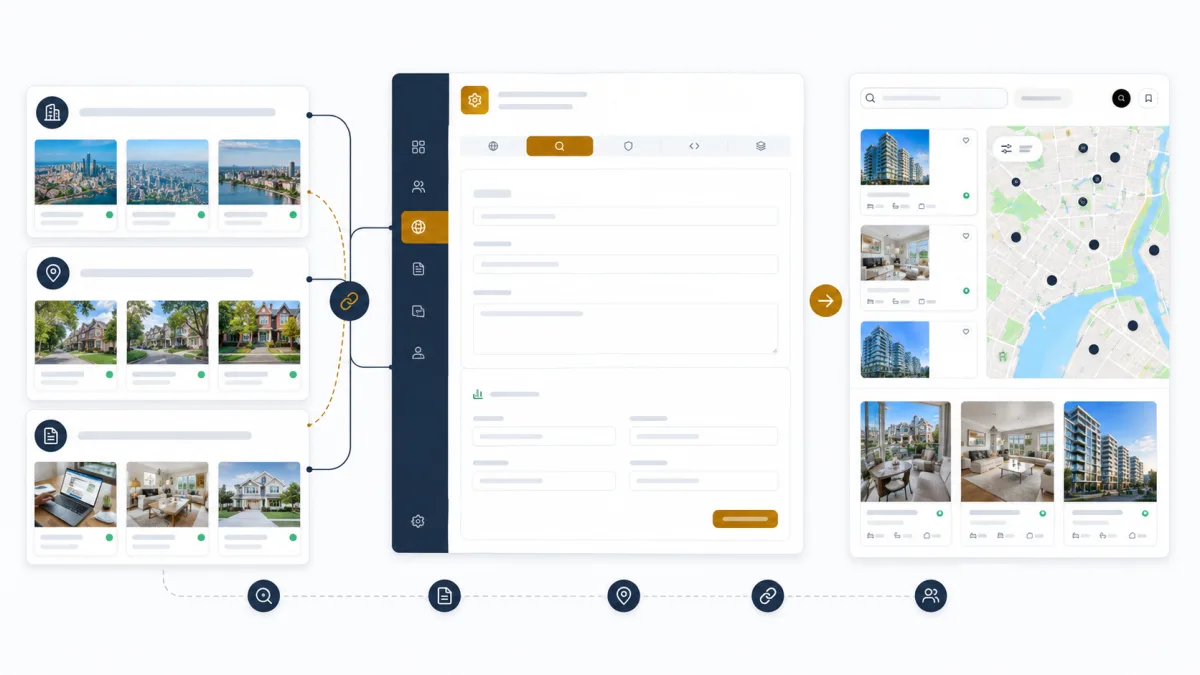
Introduction
Every agent has been told to "do SEO." Almost nobody is told which half of it is unwinnable.
Search for homes for sale in Oakville and you will find Zillow, Realtor.com, Redfin, your board's public portal, and possibly a national brokerage. You will not find a local agent — and no amount of content, links or technical work is going to change that. Those companies have domain authority you cannot accumulate, engineering teams you cannot hire, and inventory identical to yours.
Now search for what do maintenance fees actually cover at Bronte Harbour. Nothing useful comes back. Not because it is a low-value question — someone asking it is weeks from a decision — but because answering it requires having been there, and no company operating in thirty thousand markets can be anywhere in particular.
That asymmetry is the whole strategy.
⚡ Quick answer — What is real estate SEO? Real estate SEO is the practice of ranking an agent or brokerage website for property-related searches. Because national portals dominate high-volume inventory queries, effective real estate SEO concentrates on location, resource and market content that requires genuine local knowledge — the material portals structurally cannot produce at scale.
The portal blind spot
An agent in a mid-size Ontario market spends eight months on SEO. She hires a writer, publishes twenty-two articles, and buys a directory link package. Her target keyword throughout is homes for sale in Oakville and close variants.
Eleven months later she ranks 34th. Above her: four portals, her own board, two national brokerages, a rental aggregator, and a mortgage comparison site.
The content was not bad. The strategy was arithmetic she was always going to lose. She was competing for a query answerable entirely from a database — precisely the query a company with a billion-dollar engineering budget answers best.
Meanwhile a page she wrote in an afternoon and never promoted — what maintenance fees cover in Bronte Harbour buildings — ranks first, gets forty visits a month, and has produced two listings.
The structural version
Portals are not beating you because they try harder. They are beating you at a specific class of query, and they are structurally incapable of competing at another.
What scales: anything answerable from a database. Listing counts, price filters, bed and bath combinations, map boundaries. A portal generates a million such pages from one template and the content is correct on every one.
What does not scale: anything requiring presence. Which streets flood. Which building's board just approved a special assessment. Whether the school catchment changed. What $900,000 actually buys on the west side versus the east.
The strategic conclusion follows directly: stop competing where inventory is the answer, and compete where judgement is.
Why real estate SEO is different
Three things make this industry unlike most SEO work.
Your inventory is not yours. Every participating brokerage displays the same listings from the same feed. The pages carrying most of your content are identical, in substance, to your competitors'. That is not a penalty — it just means listings are not your ranking asset. They convert; they do not rank.
Your market is geographic and finite. You are not competing for national volume. You are competing for a set of postal codes, and the total addressable search is a few thousand queries a month, not millions. That sounds like a limitation. It is actually the advantage — a finite target is one you can genuinely cover.
Your competition is asymmetric. In most industries you compete with peers. Here you compete simultaneously with billion-dollar portals for one class of query and with the agent down the road for another. Treating both the same way is the mistake.
The three-layer architecture
Effective real estate sites have three content layers doing three different jobs.
Geographic hierarchy — the crawl path
Homepage
Links down into every market you serve
Market
Region or metro — the umbrella term people search
City
Where most commercial search volume sits
Community / neighbourhoodYour layer
Where you can out-write a portal
Property
Live inventory. Converts; rarely ranks
Each level links down to the next and back up. A level with nothing linking to it is invisible.
Resource layer — alongside, not inside
- Buying and selling process guides
- Cost breakdowns for your jurisdiction
- Market reports and updates
- Answers to questions that precede geography
Not part of the geographic tree, but links into it — and is the content most likely to earn links from outside real estate.
Property pages are the most numerous layer and the least likely to rank. Community pages are the fewest and the most defensible.
| Layer | Count | Lifespan | Job |
|---|---|---|---|
| Listing | Thousands | Weeks | Convert. Rarely ranks, and that is fine |
| Location | Dozens | Years | The ranking layer — where you beat portals |
| Resource | A handful | Years | The authority layer — where links come from |
Note the inversion: the layer with the most pages matters least for ranking, and the layer with the fewest matters most. Most agents spend their effort in exactly the wrong proportion.
Location pages
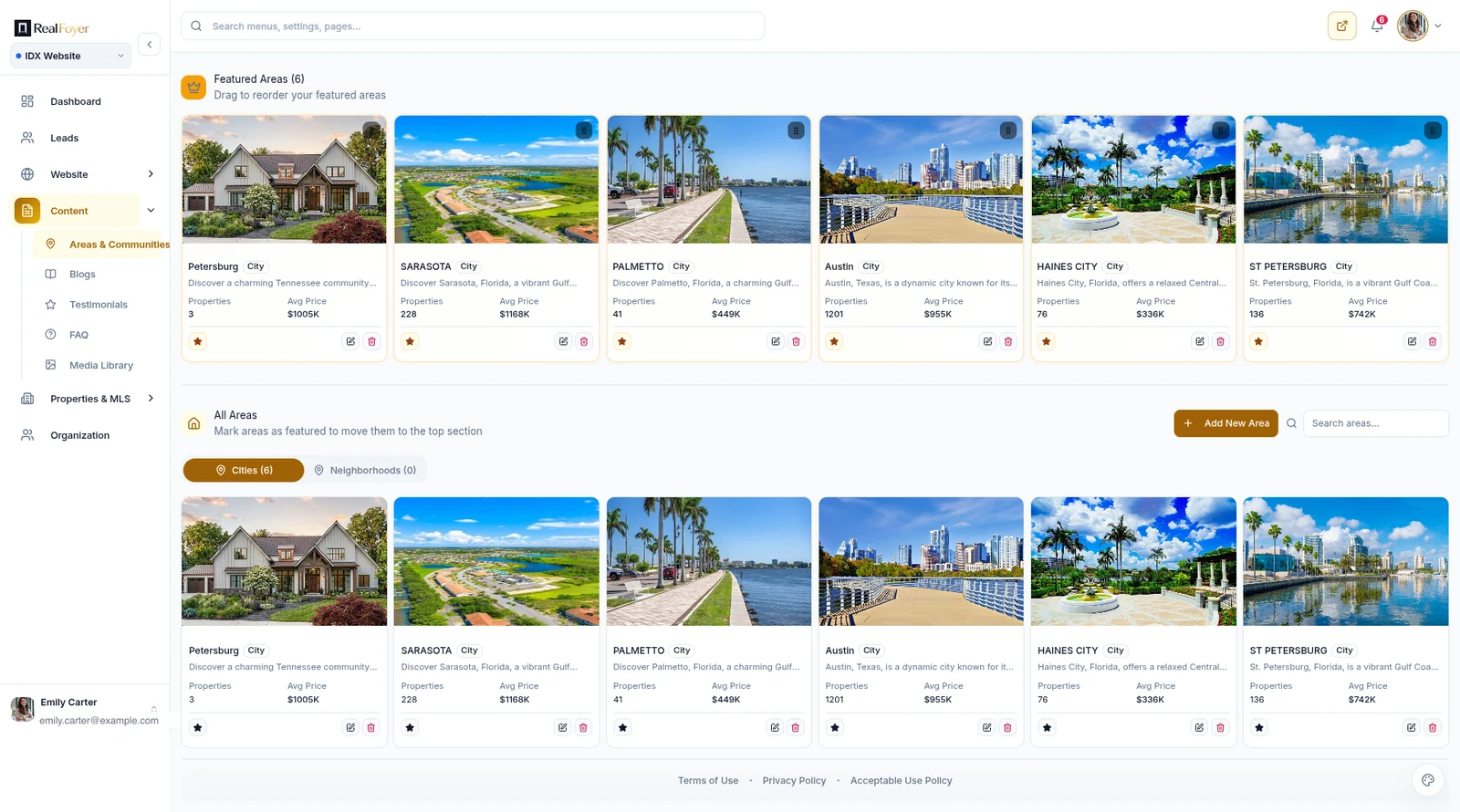
Location pages are the ranking layer: city, community, neighbourhood, sometimes individual buildings. They are where local knowledge becomes a page a portal cannot write.
They are also where most sites fail, by generating hundreds of near-identical pages from a template with a listing count swapped in. That produces thin pages at scale — the doorway problem — and it is worse than having no location pages at all.
The test for whether a location deserves a page is simple: can you write 400 words about it that nobody else could write? If not, it does not need a page yet.
For how to build one properly, see Neighborhood Pages That Actually Rank.
Resource pages
Resource pages answer the questions that come before geography. How buying works. What closing costs include. What an inspection covers.
The critical qualifier is jurisdiction. "How does a home inspection work" is generic and competes nationally. "What a home inspection covers in Ontario, and what it does not" has a defensible audience, because process genuinely differs by province and state.
Here is the mechanism that makes these pages worth more than their traffic suggests. An agent publishes an itemised closing-cost breakdown for her market: land transfer tax at four price points, legal fees with a real range, title insurance, adjustments, the municipal levy nobody expects. Roughly 900 words and one large table.
Within a year it is linked from a local credit union's first-time buyer page, two employer relocation intranets, and a community group that reposts it every spring. None of those links were requested. They happened because the page contained a number someone else wanted to cite — and a generic closing-costs article contains nothing citable.
Publish the table someone else would rather link to than rebuild.
Market pages
Market pages — prices, inventory, days on market for a specific area — occupy an unusual position. They are the only content on your site that legitimately updates often, which makes them a recurring reason for people to return and for other sites to cite you.
They are also the easiest to do badly. A page that regurgitates board statistics adds nothing. A page that explains what the numbers mean for someone buying here this quarter is genuinely yours.
Local relevance
Ranking in a market requires signals that you are actually of that market.
The mechanics — Google Business Profile, consistent business information, reviews, local links — are worth doing properly and are largely the same for any local business. What differs for real estate is the relationship between your profile and your website: profile signals help you appear in map results, while your website's location content is what competes in the organic results below them. They are different surfaces, and winning one does not win the other.
The most underrated local signal is the least technical one: content that could only have been written by someone who works the area. Street names, building names, the specifics of a catchment. Search engines are reasonably good at recognising the difference between a page about a place and a page assembled from a place's data.
Technical foundations
None of the content work matters if pages cannot be crawled, rendered or indexed — and IDX sites have a specific set of problems here, mostly caused by feeds generating thousands of near-identical filter URLs.
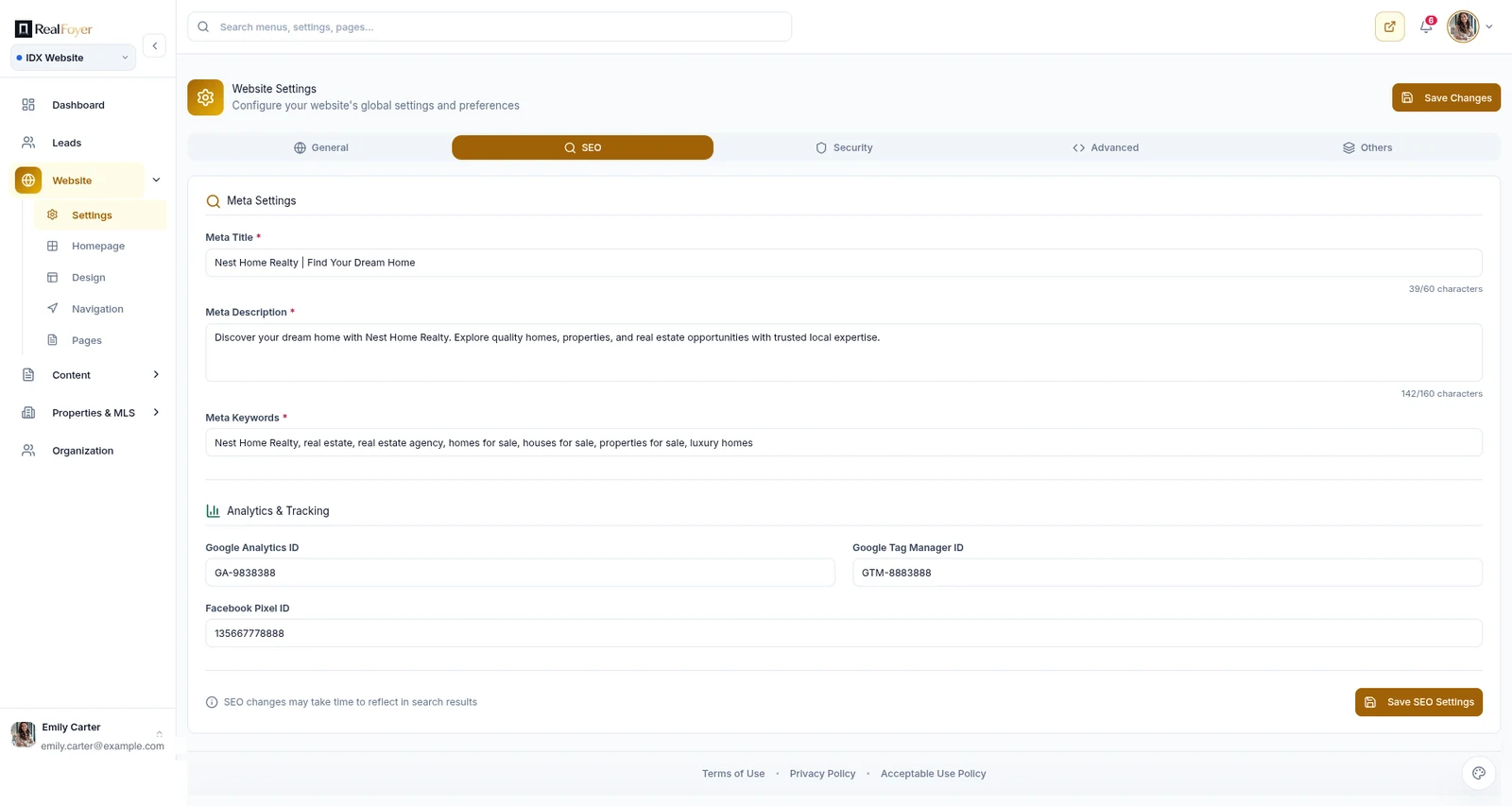
The short version: make sure every page you care about is linked from somewhere, make sure your content exists in the rendered HTML rather than arriving after a client-side fetch, and make sure crawl budget is going to pages that matter rather than to sort orders and filter permutations.
Read next: Technical SEO for Real Estate Websites covers crawling, rendering, indexation, canonicals and duplicate IDX URLs in full.
Answer engines
A growing share of search now happens in interfaces that synthesise an answer rather than returning ten links. That changes what gets cited: clear definitions, specific figures with context, and content structured so a passage can be lifted and remain accurate on its own.
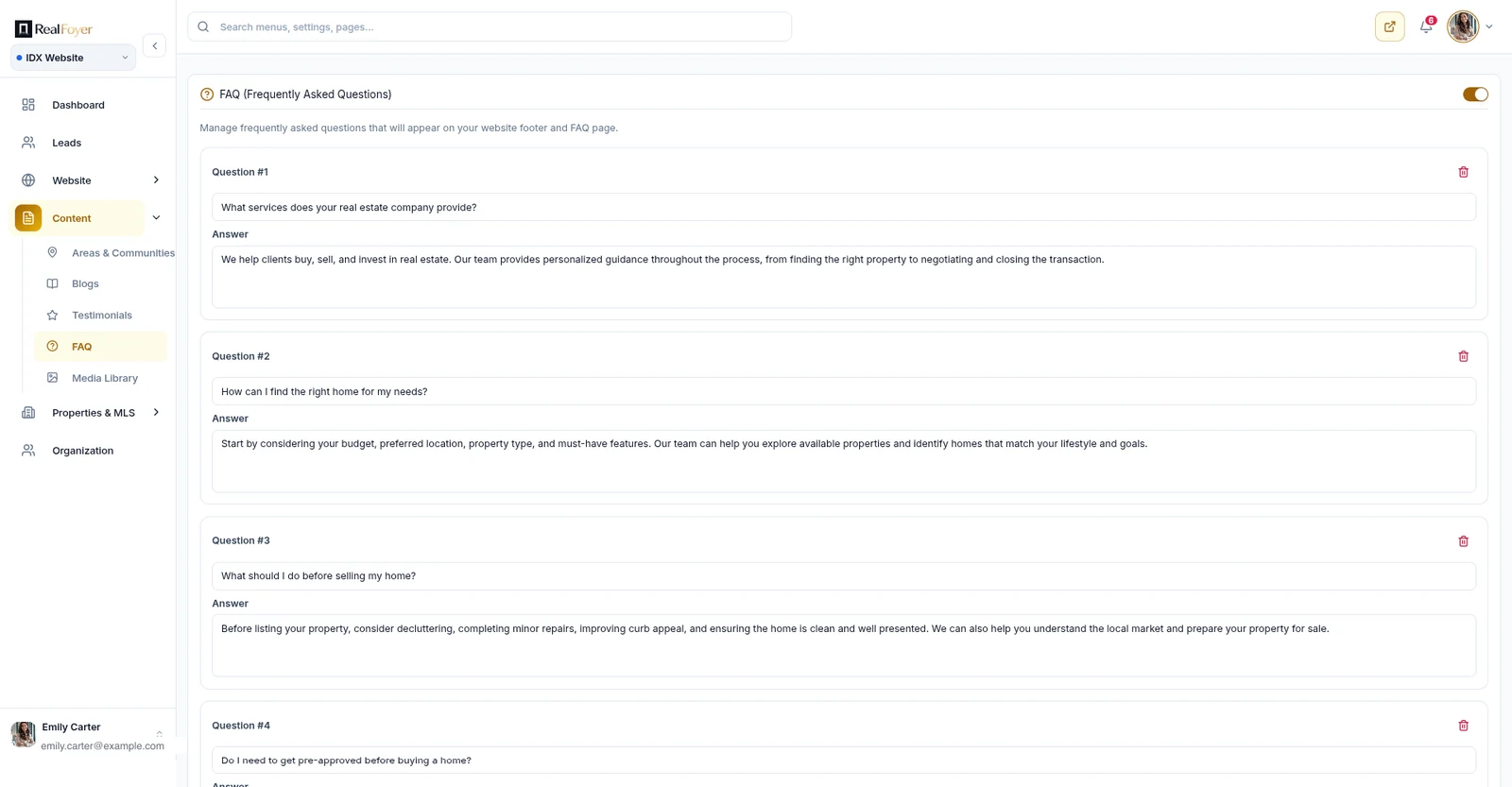
Much of this overlaps with writing well for people. Direct answers near the top of a section, plain definitions before elaboration, and specifics rather than hedged generalities all help both audiences.
What nobody can honestly promise is that any particular technique guarantees citation in an AI answer. Treat it as improving your odds, not as a mechanism.
Measurement
Most real estate SEO reporting measures activity. The useful metrics connect a search to a conversation.
| Metric | What it tells you |
|---|---|
| Organic traffic to location pages | Whether your ranking layer is working — the number that matters most |
| Queries in positions 11–20 | The cheapest available traffic. Already relevant, needs depth |
| Pages indexed vs published | Whether anything is stuck before it can rank |
| Leads by landing page | Which content produces conversations, not just sessions |
| Return visitors | Whether the site earns a second visit |
Two things worth ignoring: total pageviews, which tells you nothing about intent, and rankings for head terms you were never going to win.
A note on timelines. Search work compounds slowly, and how long it takes depends on your market, your site's current state and how much competition there is for the specific queries you target. Be sceptical of anyone offering a fixed schedule.
How the pieces fit
If you take one thing from this guide, take the order of operations.
- Fix the technical foundations so pages can be indexed at all.
- Build location pages for areas you genuinely know, one at a time, properly.
- Publish resource content with citable specifics for your jurisdiction.
- Add market pages once you have something to say about the numbers.
- Measure by landing page, and put the next month's effort where last month's leads came from.
Most agents attempt these in reverse, starting with volume-chasing blog posts and never fixing indexation. That is the arithmetic in the story at the top of this article.
The infrastructure underneath — clean URL architecture, pages that render server-side, a site that stays fast with a live feed attached — is largely a platform concern rather than something an agent configures. See RealFoyer IDX websites for how that side is handled.
FAQ
How long does real estate SEO take? It depends on your market, your site's current state and the competition for your specific queries. Anyone quoting a fixed number is guessing. What you can control is whether pages are indexable and whether the content is genuinely local.
Should I target "homes for sale in [city]"? Usually not as your primary goal. It is dominated by portals with structural advantages. Target it as a secondary outcome of a strong city page, not as the objective.
How many location pages should I have? As many as you can write with genuine local knowledge, and no more. A dozen good ones beat two hundred templated ones.
Do I need a blog?
You need resource content. Whether it lives under /blog is a URL decision, not a strategy. What matters is that it answers questions specific to your jurisdiction.
Is my IDX listing content hurting my SEO? Not as a penalty. Listing pages simply are not distinctive enough to rank competitively, since every participant shows the same records. The risk is crawl waste from filter URLs, which is a technical problem with a technical fix.
Can I outrank Zillow? For inventory queries, no. For questions requiring local judgement, routinely — and those visitors are usually closer to a decision.
In short
Real estate SEO is not a fair fight, and pretending otherwise is what wastes budgets. Portals win every query answerable from a database. They cannot win the ones that require having been somewhere.
Build the layers in order: a site that can be indexed, location pages only where you have real knowledge, resource content with citable specifics, and measurement that ends in a conversation rather than a pageview.
Explore RealFoyer IDX websites, or book a demo to look at your market's search landscape.
Related reading
- Local SEO for Real Estate Agents
- Technical SEO for Real Estate Websites
- AEO for Real Estate: How to Get Found in AI Search
- Real Estate SEO: Your First 90 Days
- Real Estate City & Market Pages
- Neighborhood Pages That Actually Rank
- Real Estate IDX Websites: The Complete Guide
- Real Estate Website Conversion
Research Integrity
Restructured 16 August 2026. Detailed technical material moved to Technical SEO for Real Estate Websites rather than being duplicated here. Sections on local SEO, answer engines, city and market pages and the first ninety days are summarised pending their own articles; links will be added when those are published. The previous version's fixed SEO timelines and traffic figures have been removed rather than replaced with estimates, and no claim is made that any technique guarantees citation in AI answers. Illustration specifications that were being published as article content have been removed.