IDX & MLS
Real Estate IDX Websites: The Complete Guide for Agents, Teams & Brokerages
What IDX is, how MLS listings reach your website, what a working IDX site is made of, and what to check before you buy — for agents, teams and brokerages.
Introduction
There are two kinds of real estate websites.
The first is a brochure. Your headshot, an About page, a contact form, and a listings section fed by your MLS. It looks fine. It generates almost nothing, and after eighteen months you quietly stop opening the analytics.
The second is an acquisition channel. It ranks for the neighbourhoods you actually sell in, captures a search before the buyer reaches a portal, and hands that lead to the right agent with the context attached.
The difference between them is rarely the theme. It is the plumbing underneath — how listing data arrives, whether search engines can index it, and what happens in the minutes after a form submission.
This guide covers what IDX is, what an IDX website is actually made of, and what to check before you buy one. Where a topic deserves its own treatment, it gets a link rather than a section.
⚡ Quick answer — What is an IDX website? An IDX website is an agent or brokerage website that displays live MLS listings under an Internet Data Exchange agreement. IDX is the permission framework that lets you show other brokerages' listings on your own site, provided you follow your MLS's display and attribution rules. It is an agreement, not a piece of software.
What IDX actually is — and what it isn't
IDX — Internet Data Exchange — is a reciprocal agreement between MLS-participating brokerages. Each permits the others to display its listings online. If you are a participant in good standing and you sign your board's IDX agreement, you may publish the pooled inventory on your own site.
Three distinctions matter, and conflating them causes most of the confusion:
IDX is not the MLS. The MLS is the database of record and the cooperation agreement between brokers. IDX is a downstream permission to display a defined subset of it publicly.
IDX is not VOW. A Virtual Office Website can show more than IDX allows — in some markets including sold history — but requires a registered broker-consumer relationship with a login and a written agreement. Most agent sites are IDX-only.
IDX is not syndication. Syndication pushes your own listings out to portals. IDX pulls the pooled inventory in. Opposite directions, different agreements.
MLS
The MLS
The source database
- Who sees it
- Licensed members only
- What it carries
- Full listing record, including fields never shown publicly
- For example
- Showing instructions, seller notes, commission terms
IDX
IDX
Public display feed
- Who sees it
- Anyone visiting your site
- What it carries
- The subset the MLS permits you to publish
- For example
- Photos, price, beds, baths, description
VOW
VOW
Registered-user feed
- Who sees it
- Visitors who register and accept terms
- What it carries
- A wider subset than IDX, where the MLS allows it
- For example
- Some sold data and history, varies by MLS
What each feed may carry is set by your MLS and licensing agreement, and differs between boards.
Your site versus a portal
Agents reasonably ask why they should run property search at all when the portals exist. You will not beat them on search volume. The two assets do different jobs.
| Your IDX website | A national portal | |
|---|---|---|
| Who owns the lead | You | The portal, until sold to you |
| Lead cost | Fixed platform cost | Per lead, competitive by area |
| Exclusivity | Yours alone | Often shared |
| Behavioural data | Every view, save and return visit | Little or none passed to you |
| Branding | Yours | Theirs, with your photo on it |
| Compounding | Content accrues over time | Spend stops, leads stop |
Portals are a rented audience; your site is an owned one. Most working agents need both for a period, and the goal is to shift the mix.
How listing data reaches your site
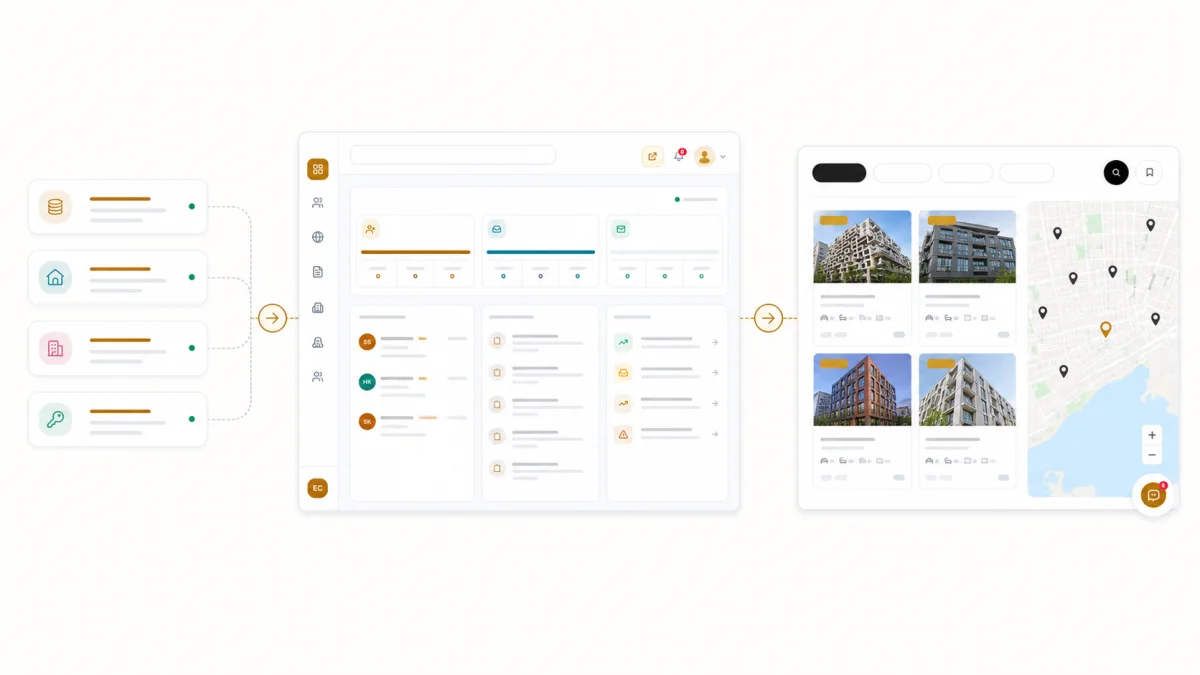
Between the MLS and a listing page sits a pipeline: your MLS exposes data through a feed, an integration layer pulls it, fields are normalized into a consistent shape, records land in a database, a search index makes them queryable, and your site renders them.
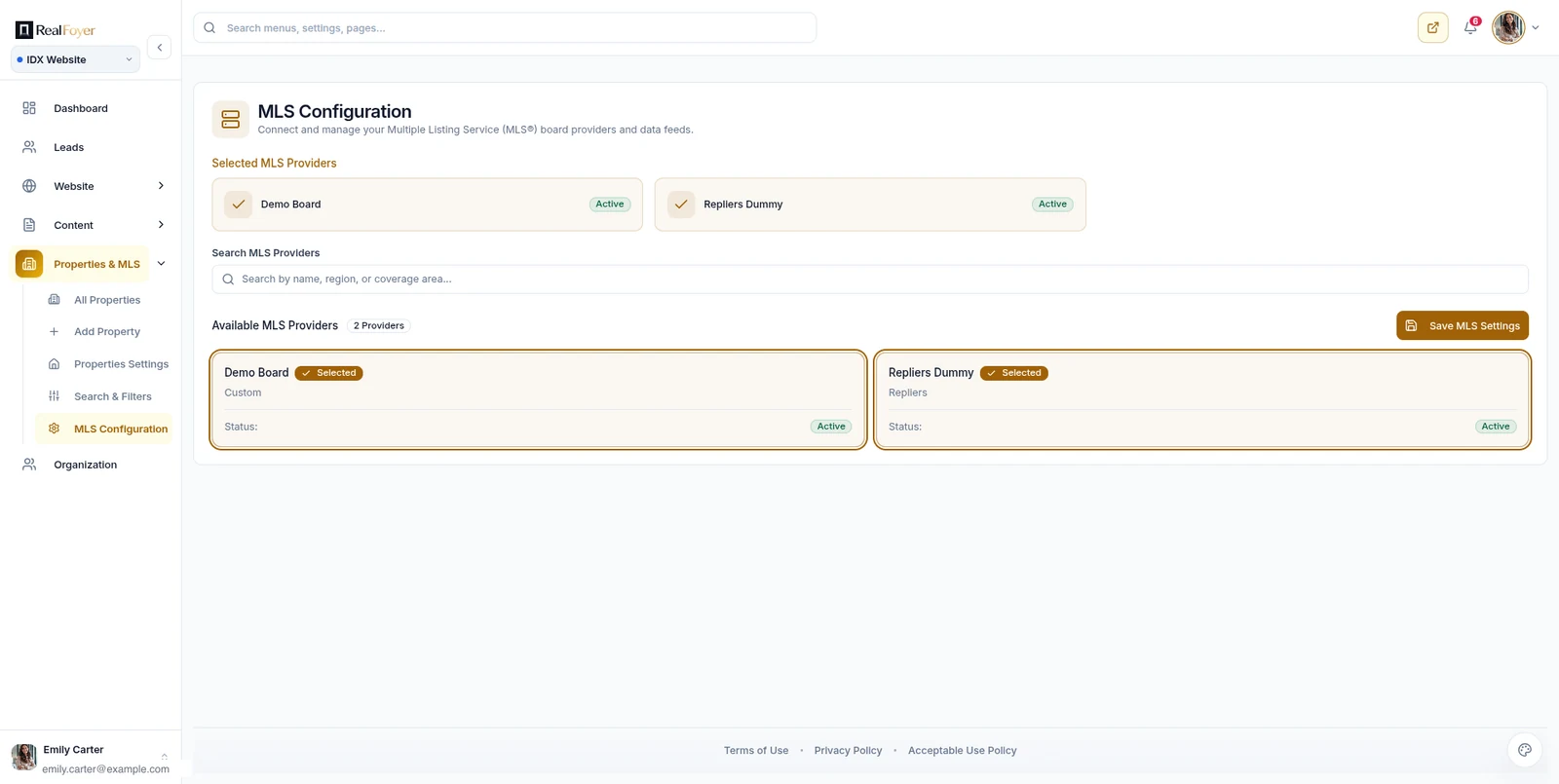
Each hop can fail quietly. Field mapping is the usual culprit — one board's LivingArea is another's SqFtTotal, and a mismatch shows up as blank facts rather than an error. Media is the second: photos usually arrive as URLs that must be fetched, resized and served from your own infrastructure.
The practical consequence for buyers is that "we integrate with your MLS" is not one capability. It is a per-board integration, and coverage varies.
Read next: MLS Integration: How Listing Data Actually Reaches Your Website walks the full pipeline, including how updates and deletions propagate.
What an IDX website is made of
Strip away the marketing and a working IDX site is five things that have to work in sequence.
- 1
Search
Filters, map, saved criteria
- 2
Results
Ranked list, map pins, quick view
- 3
Listing detail
Photos, facts, attribution
- 4
Register
Save a home or an alert
- 5
Lead
Contact record with search history
Registration requirements and what may be shown before it differ by MLS.
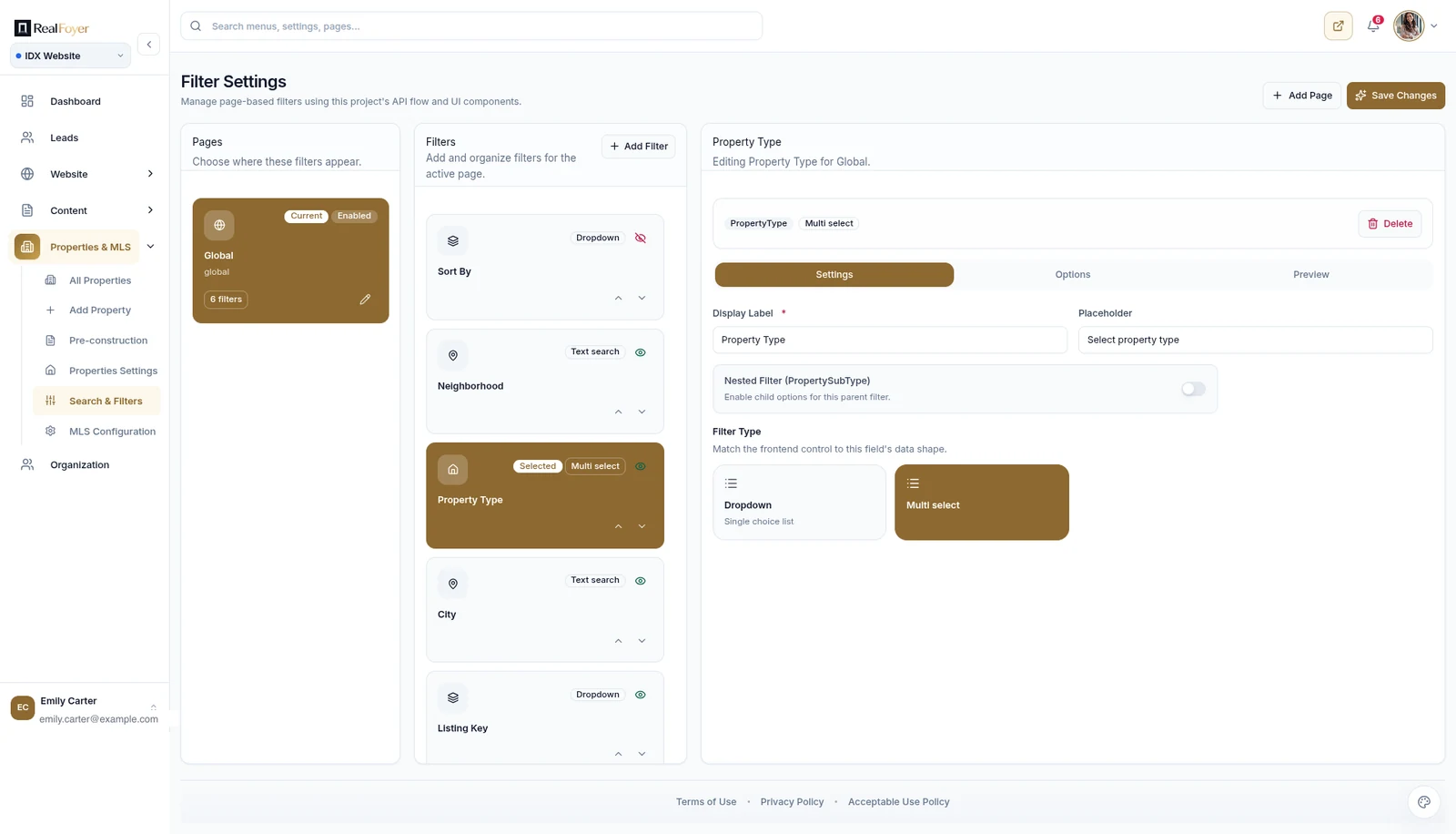
Listing search. Filters that match how buyers actually think — price, beds, baths, area, property type — and that produce a shareable URL. If a filtered result cannot be linked to, it cannot be saved, sent or indexed.
Results and map search. Most buyers navigate by area before anything else, which is why map search is the primary interface rather than a feature. Drawing a boundary and saving it is the highest-intent action on most sites.
Listing detail pages. Photos, facts, and the attribution your MLS requires. This is also where compliance obligations are most visible.
Registration and saved searches. Registration is a trade: the visitor gives an email, you give them alerts on inventory they care about. A saved search is worth more than a contact form submission because it keeps producing reasons to make contact.
Lead capture. The lead record should arrive carrying what the person looked at, not just their name. That context is the difference between an informed first call and a cold one.
The compliance layer
Displaying other brokerages' listings comes with obligations. Broadly, IDX sites are expected to attribute listings to the listing brokerage, display required disclaimers, refresh data on an expected cadence, and use the data only for permitted purposes.
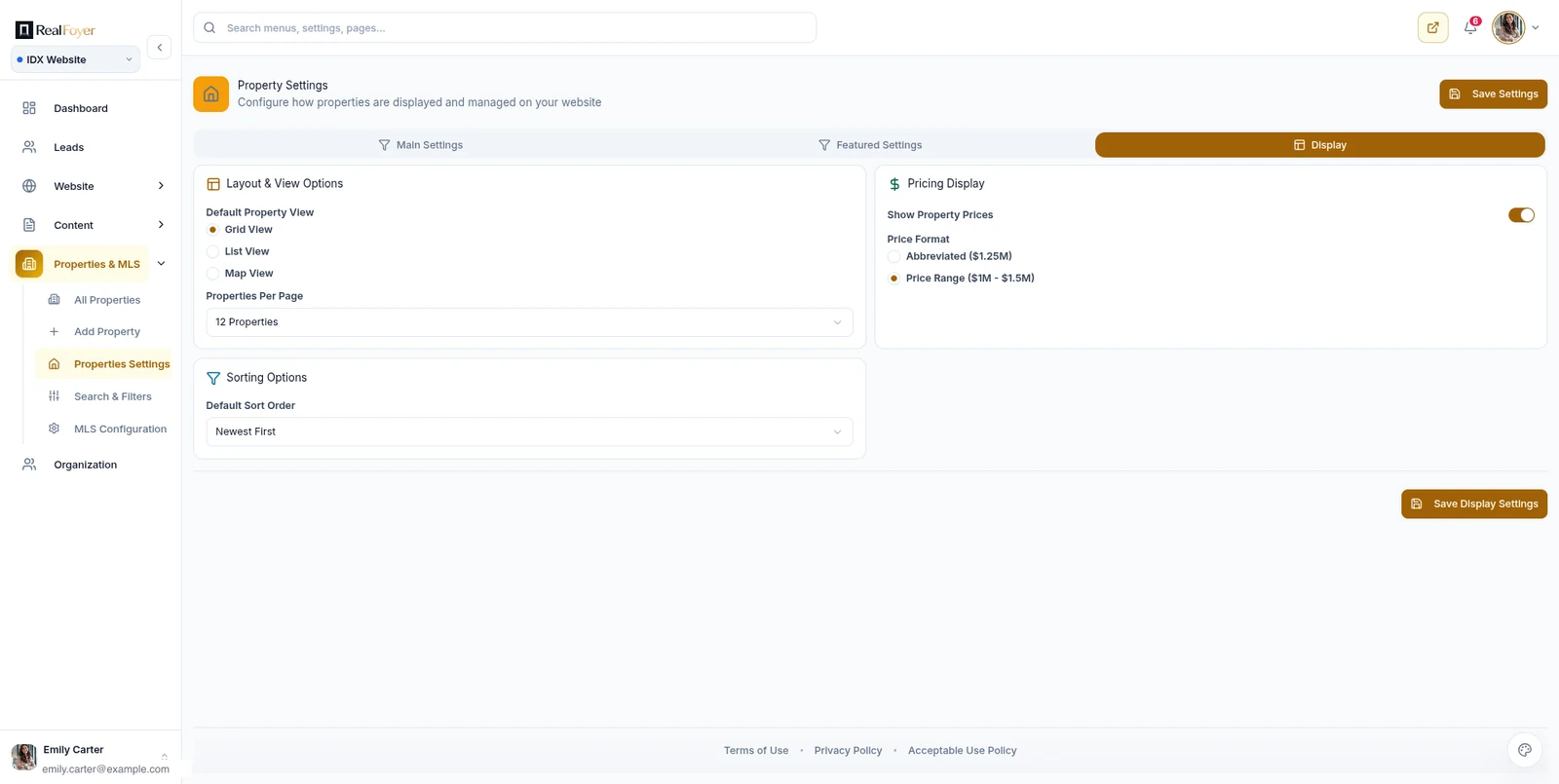
The important caveat: requirements vary by MLS, board and licensing agreement. Attribution wording, whether sold data may be shown at all, how quickly withdrawn listings must disappear, and what constitutes permitted use are set locally. Anyone who tells you there is one national standard is describing their own market.
Treat compliance as a per-board configuration, not a feature checkbox — and confirm specifics with your MLS rather than a vendor.
Read next: MLS & IDX Compliance: What Your Real Estate Website Must Handle covers attribution, disclaimers, refresh expectations and permitted use.
Why IDX websites struggle to rank
IDX creates a specific SEO problem: a feed can generate thousands of near-identical URLs — the same listings under filters, sorts and pagination — and most of them offer search engines nothing distinct to index. Sites frequently accumulate large numbers of listing URLs that sit crawled but not indexed.
The listings themselves are also the least defensible content you have. Every other participant displays the same records. What ranks is the material that is genuinely yours: area pages written from actual local knowledge, and resources that answer questions the feed cannot.
Read next: Technical SEO for Real Estate Websites covers crawling, indexation, canonicals and duplicate IDX URLs. For the wider strategy, see Real Estate SEO: The Complete Guide and Neighborhood Pages That Actually Rank.
What happens after the lead
A website's job ends at the lead record. What happens next decides whether the traffic was worth anything.
Three things matter in sequence: the lead reaches the right agent, it reaches them quickly, and the follow-up continues without depending on anyone's memory. A site that captures well and hands off badly produces expensive nothing.
Read next: Real Estate CRM: How Agents, Teams and Brokerages Should Actually Use One, and Real Estate Website Conversion for the stages between anonymous visitor and qualified lead.
Teams and brokerages
The requirements change with size.
An individual agent needs one site, one feed and a simple follow-up sequence. A team adds routing — who receives which lead, on what basis, and what happens when nobody responds. A brokerage adds agent subsites, permissions, brand consistency and the question of what happens to a departing agent's data.
That last point is worth settling before signing anything: agree in writing what happens to your listings, content and contact history if you leave the platform.
Choosing a platform
Most evaluations focus on templates. Templates are the easiest thing to change and the least consequential.
The questions that matter are whether the platform holds an active feed with your board, how listing URLs are structured and whether they can be indexed, whether you own your content and contact data, what the CRM does with a lead once captured, and how the platform handles compliance differences between boards.
What to measure
Most real estate dashboards report activity rather than outcomes.
| Metric | Why it matters |
|---|---|
| Time to first contact | The most leveraged variable in the funnel |
| Lead → appointment rate | Tests lead quality and follow-up together |
| Organic traffic to area pages | Whether your ranking layer is working |
| Saved-search signups | High intent, and a recurring reason to make contact |
| Source attribution coverage | You cannot optimise what you cannot attribute |
What to stop reporting: total pageviews, total leads without a source, and email opens in isolation. None of them tell you what to do next.
FAQ
Do I need an MLS membership to have an IDX website? Yes. IDX access flows from MLS participation and a signed IDX agreement with your board. A vendor cannot provide access on your behalf without it.
Can I show sold listings on my website? It depends on your MLS. Some permit sold data on IDX displays, some only behind VOW registration, and some not at all. Confirm with your board before assuming.
How long does it take to get an IDX feed? This varies by board, and by how much of the paperwork is already complete. Some approve in days, others take considerably longer. Ask your MLS directly rather than relying on a vendor's estimate.
Is IDX the same as an MLS feed? Not quite. The feed is the technical delivery of data. IDX is the permission that lets you display it publicly. You need both.
Will an IDX website rank on its own? No. Listing pages are duplicated across every participant in the market. Ranking comes from content only you can produce — genuine area knowledge and useful resources — supported by a site search engines can crawl.
What happens to my site if I change brokerages? That depends on your platform agreement and your board's rules. Establish before you sign who owns the content, the domain and the contact records.
In short
IDX is a permission, not a product. The site around it earns its keep through three things: listing data that arrives complete and stays current, pages search engines can actually index, and a handoff to follow-up that does not depend on anyone remembering.
If you are evaluating platforms, start with feed coverage for your specific board and data ownership. Templates can be changed later; those two cannot.
Explore RealFoyer IDX websites to see how these pieces fit together, or book a demo to walk through your market's requirements.
Related reading
MLS Integration: How Listing Data Actually Reaches Your Website
MLS & IDX Compliance: What Your Real Estate Website Must Handle
RETS vs RESO Web API: What Real Estate Professionals Should Know
How to Choose an IDX Website Platform: A Practical Checklist
Research Integrity
This article was rewritten on 16 August 2026 under RealFoyer's current editorial workflow. Unsourced statistics carried by the previous version — including speed-to-lead decay figures, mobile-search percentages and MLS approval timelines — have been removed rather than replaced with estimates. Statements about MLS rules are deliberately scoped as varying by board, because they do. Product capability statements are limited to what the linked product pages describe.