CRM & Leads
Speed to Lead in Real Estate: Why Response Time Matters
Why fast response wins real estate enquiries: the parallel-enquiry mechanism behind it, four coverage models, and how to measure response time honestly.
Introduction
An enquiry arrives at 8:47 on a Tuesday evening. What happens in the next few minutes decides more than almost anything else in your lead process — and for most agents, what happens is nothing until morning.
This article is about closing that gap: why it matters, what mechanism actually explains it, and how to cover evenings and weekends without pretending you can be available at all times.
One thing up front. You will find a lot of very specific numbers attached to this topic — respond in five minutes or lose 80% of something. Most of them do not survive checking. This article makes the case without them, because the case does not need them.
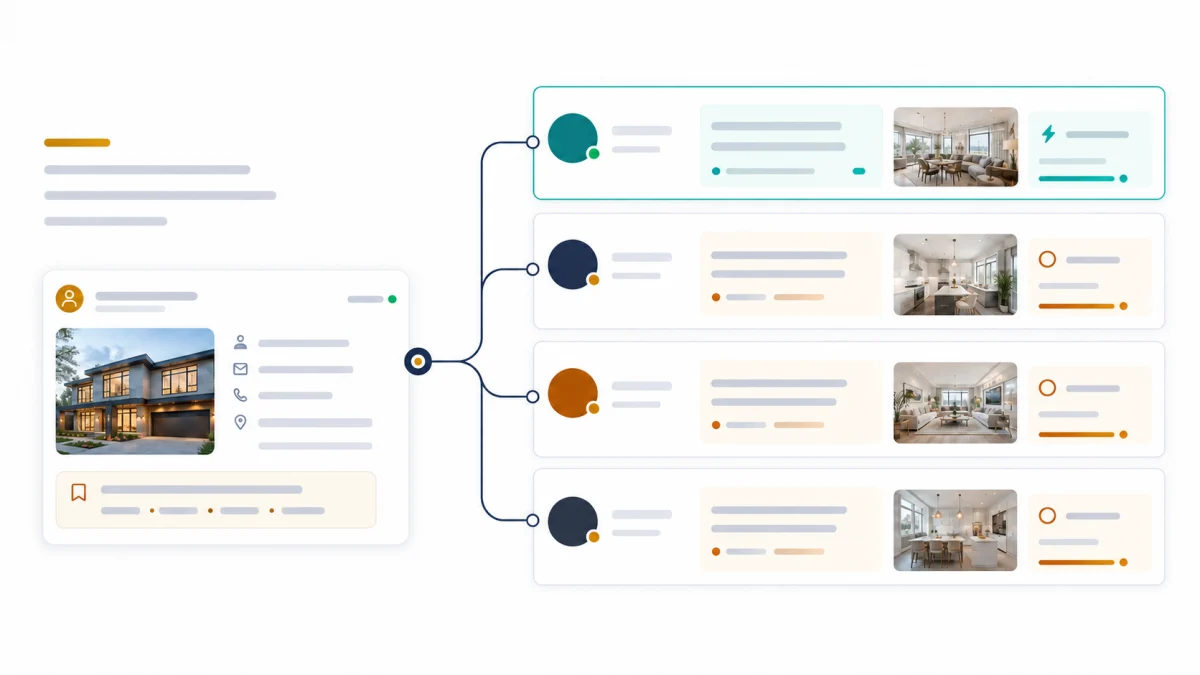
⚡ Quick answer — how fast should you respond to a real estate lead? Fast enough to be first, which is a competitive question rather than a fixed number. Buyers rarely enquire once — they enquire on several properties in a sitting, often across several agents. You are not racing a decay curve, you are racing the other people who received the same enquiry. In a market where nobody answers until morning, twenty minutes wins. In a competitive one, it doesn't.
What speed to lead actually measures
Time from enquiry submitted to a real human attempt to make contact.
Three clarifications, because this is where teams fool themselves:
An automated acknowledgement is not a response. It is useful — it tells the person their enquiry landed — but it does not start a conversation. Counting it as your response time produces excellent metrics and unchanged results.
An attempt is not a contact. Both are worth measuring. A team with a two-minute first attempt and a 20% reach rate has a different problem from one with an hour and 70%.
Median hides everything. A median of four minutes with a 90th percentile of nine hours describes a team that is fast when someone happens to be free. The tail is where the losses are.
Why the clock matters
Most writing on this topic presents response time as decay: interest cools, so hurry. That is true and it is the less important half.
The mechanism that actually decides it is parallel enquiry.
A buyer browsing on a Tuesday evening does not find one property and stop. They open several, and they enquire on the ones that interest them — often across different agents' sites and portals, within the same twenty minutes.
What follows is not a decay curve. It is a race with a single winner. The buyer talks to whoever reaches them first with something useful, and that conversation establishes a relationship the others are then competing against rather than starting fresh alongside.
That reframing changes the priorities:
- Being early beats being polished. A competent call at minute six beats an excellent one at hour three.
- The gap between first and second is what matters, not your absolute time. Ninety minutes is disastrous in a competitive market and perfectly adequate in one where nobody responds until morning.
- After-hours is where races are won, because that is where most of your competitors are not running.
About the numbers
The most-repeated figure in this field — 391% higher conversion when responding within one minute, usually credited to MIT — is Velocify platform data, not an MIT finding. The genuine MIT/InsideSales study exists, and its dataset skews toward mortgage, insurance and education: high-volume, phone-heavy verticals that do not obviously resemble residential resale. Several other widely quoted figures have no traceable source at all.
Lead scoring for real estate works through that citation trail in detail. The short version: the argument for responding quickly stands on the parallel-enquiry mechanism, which you can observe in your own data, and does not need a borrowed multiplier.
The response sequence
- 1
Enquiry arrives
Form, saved-search signup, valuation request or a call
Fails as — It lands somewhere nobody is watching at 8:47pm
- 2
Ownership is established
One named person is responsible for this lead
Fails as — Everyone assumes someone else has it, so nobody does
- 3
Context is read
Properties viewed, searches saved, what the enquiry actually asked
Fails as — Calling blind and opening with “how can I help?”
- 4
First response
A real answer to the question they asked, on a channel they used
Fails as — A polished response tomorrow instead of a competent one tonight
- 5
Outcome logged
Reached, missed, what they said, what changed
Fails as — Nothing recorded, so the next attempt starts from zero
- 6
Next action scheduled
A specific thing, on a specific day, for a stated reason
Fails as — “Follow up sometime” — which means never
An operating sequence, not a stopwatch. RealFoyer can automate routing and the initial follow-up while escalating the moments that need a person.
The thing worth noticing is that "respond faster" is almost never the useful instruction. Every delay in a slow process lives in the gaps — the enquiry sitting unnoticed, the ambiguity about whose it is, the agent who saw the alert but had no context and put it off.
When leads actually arrive
Enquiry volume follows browsing behaviour, and people browse property listings in the evening and at weekends. That is precisely when a normal business is least covered.
You do not need a study for this. Pull your own enquiry timestamps for the last ninety days and plot them by hour. Whatever pattern you find is the one you have to cover, and it is more reliable than anyone else's benchmark.
Two things usually fall out of that exercise: a weekday evening peak, and a Sunday cluster. Then compare it against when your responses actually go out. The gap between those two charts is the whole problem, stated precisely, and it usually makes the coverage decision for you.
Four coverage models
| Model | How it works | Realistic latency | Best for | Main weakness |
|---|---|---|---|---|
| Solo best-effort | You respond when you see it | Hours, unpredictable | Very low volume | Collapses exactly on your busiest weeks |
| Team rotation | An on-call agent covers evenings and weekends | Tens of minutes | Teams of three or more | Needs genuine buy-in; fails quietly when unenforced |
| Inside sales agent | A dedicated person qualifies and books | Minutes | High volume | Only economical above a real volume threshold |
| Acknowledge-then-human | An automatic acknowledgement holds the thread; a person follows | Seconds, then human | Solo agents and small teams | Buys time; does not replace contact |
Most agents are running solo best-effort without ever having chosen it. It is what happens when no decision is made.
On the fourth model, honestly. An automated acknowledgement does not respond to a lead. It holds the door — it tells the person their enquiry landed and a name is coming, converting a silent gap into a short wait.
The failure is treating it as a response. An automated email followed by nothing produces the worst available outcome: the buyer believes they have been contacted, and you believe you have responded. If you use one, the human follow-up is the commitment, not the acknowledgement.
What the first message should say
The response that wins is not the fastest one. It is the fastest one that is about their question.
The enquiry tells you which property. The record may tell you what else they looked at. Use it:
Answer the actual question first. If they asked whether the basement is finished, the first sentence is about the basement. Not "thanks for your interest."
Reference something specific. One concrete detail about the property or the area proves a person read it.
Make one clear next step. A question they can answer in a sentence, or a specific time offered. Not "let me know if you have any questions", which is an exit, not an invitation.
Match the channel. Someone who sent a form at 9pm may prefer a reply by email at 9pm and a call tomorrow. Someone who left a phone number probably expects it to ring.
Be brief. Two short paragraphs. A long response written quickly reads as a template.
Consent, briefly
Response speed pushes people toward channels with rules attached. Requirements differ by jurisdiction and change; this is not legal advice.
The general shape: an enquiry is a reasonable basis to reply to that enquiry, on the channel used, about the thing asked. It is a much weaker basis for ongoing marketing on a different channel. If you are moving people onto SMS or a marketing list, look up your obligations properly — in Canada CASL, in the US TCPA and CAN-SPAM — or have someone qualified set the rules once.
The practical habit: keep a record of how each person came to you and what they agreed to. Whatever your obligations turn out to be, you will need that record.
Measuring it honestly
Four numbers, and only the first is commonly tracked:
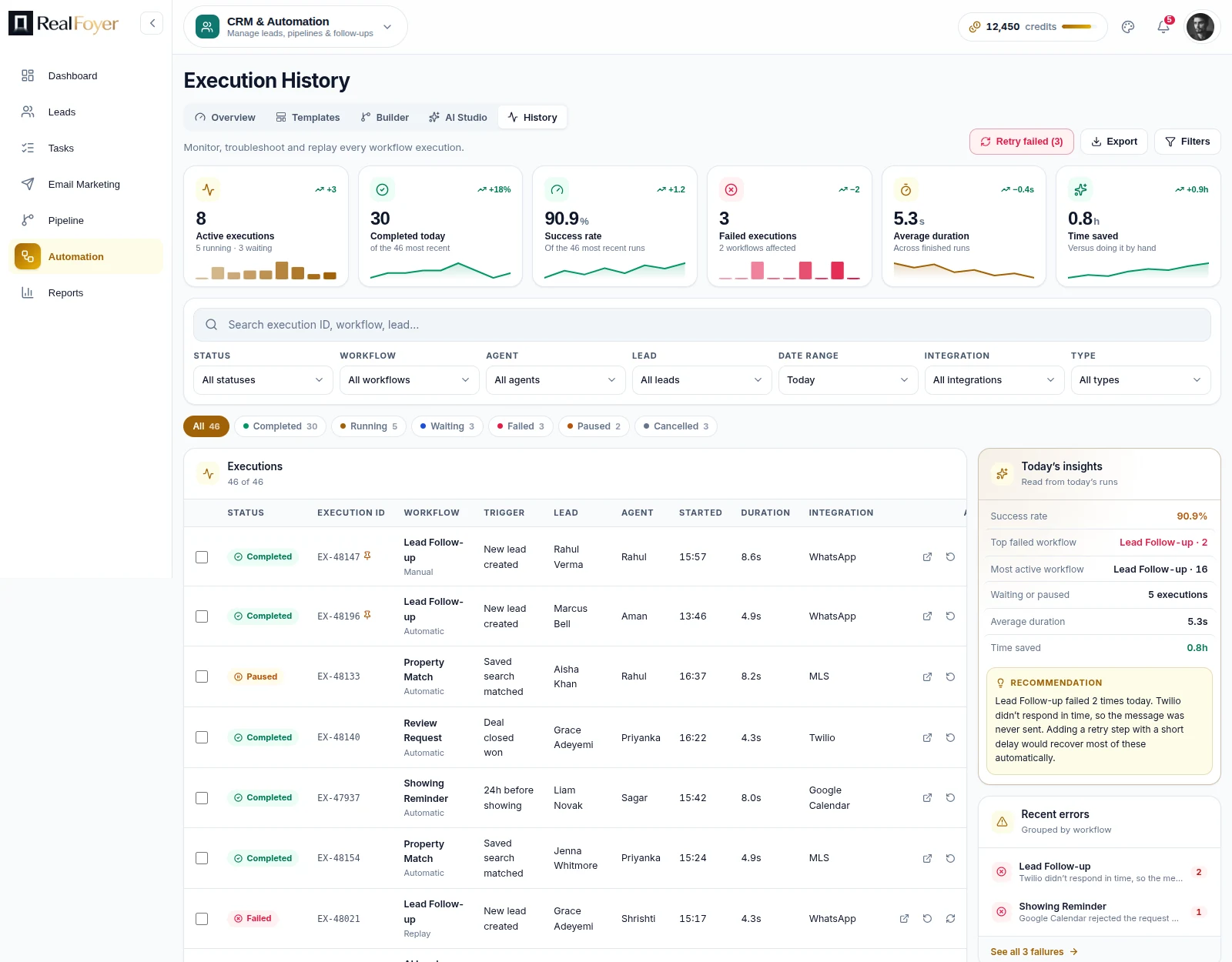
Median time to first human attempt. Attempt, not automation.
90th percentile of the same. Where your actual losses are. If p90 is a working day, you have an after-hours problem no median will show.
Contact rate. What fraction of attempts reach a person. Speed with a low reach rate is a channel problem, not a timing one.
Conversation-to-appointment rate. Whether being first is producing anything.
The failure mode: optimising the median by counting automated acknowledgements, which improves the number and nothing else.
Where RealFoyer fits, precisely
Being specific here, because this topic attracts vague automation claims.
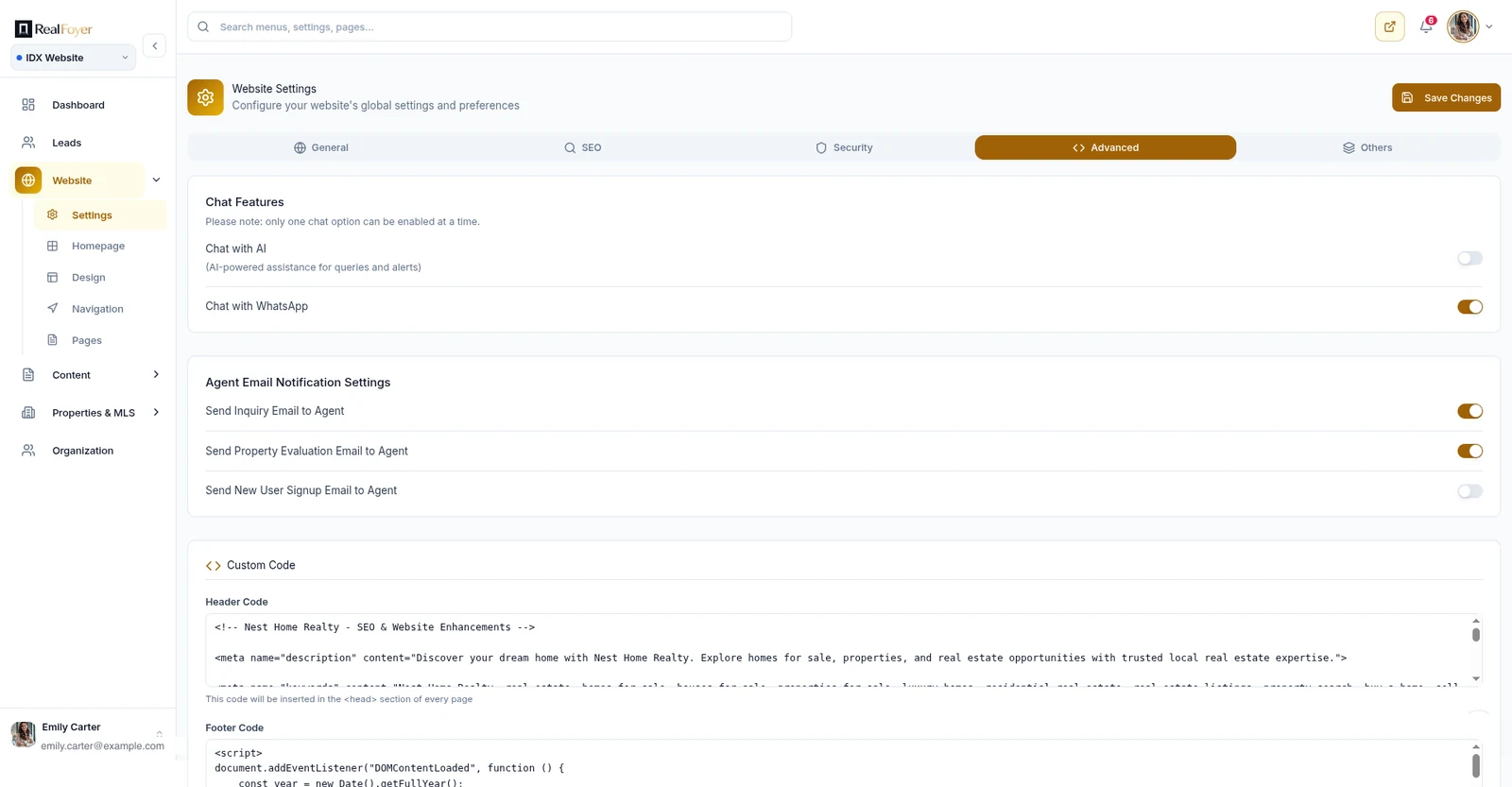
RealFoyer captures the enquiry into a lead record, with the website activity attached — the properties viewed and the searches saved that make an informed first response possible. It records activity and notifications so a new enquiry surfaces rather than sitting in an inbox. A team lead can assign the lead to a specific agent, and the assignment lands on the timeline. Calls and conversations are logged against the record, and appointments and tours are booked against it.
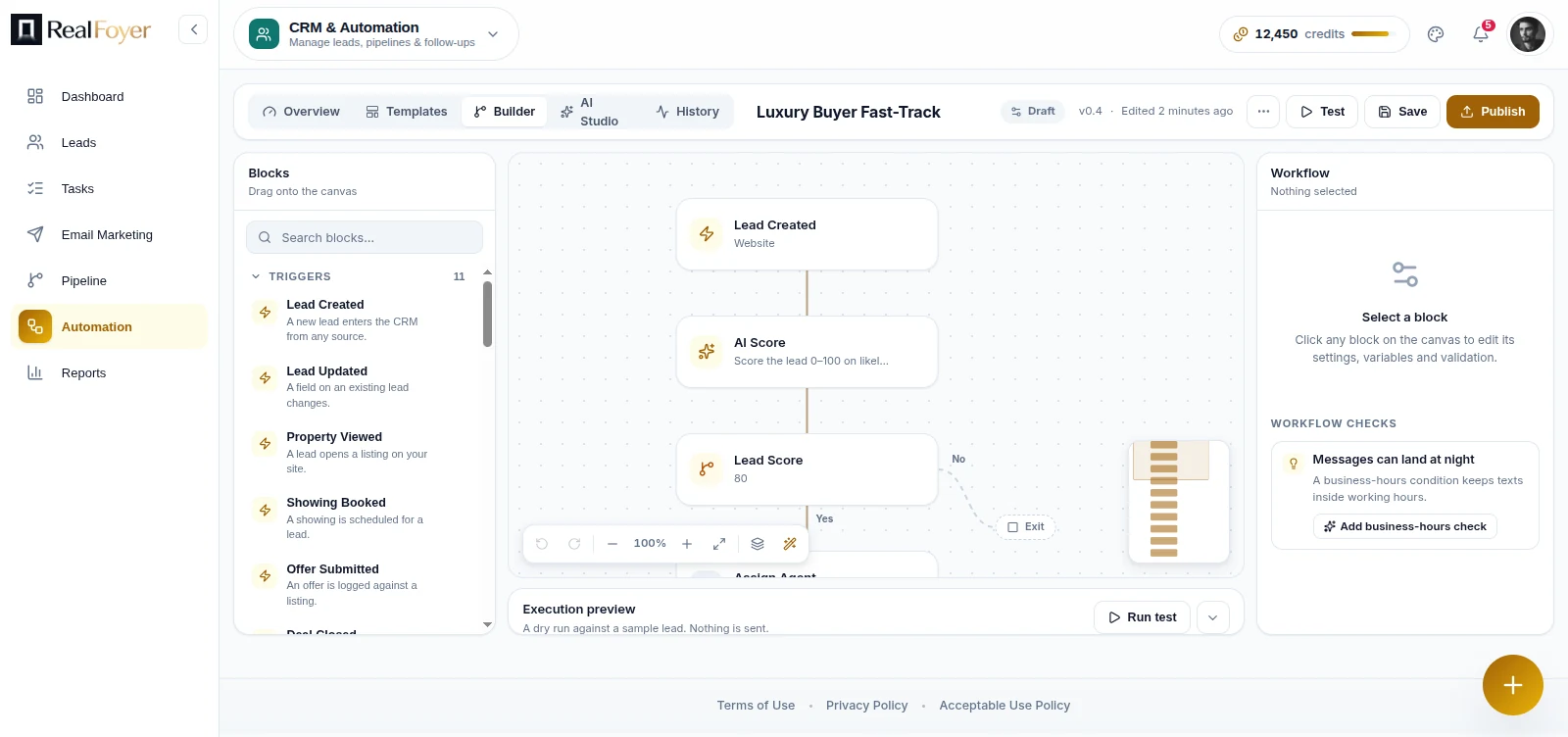
RealFoyer can route leads automatically through round robin and configurable rules, start follow-up and nurture sequences, and escalate the lead to the assigned agent when personal attention is needed. Calls, SMS and WhatsApp remain separate from these CRM automation workflows.
Coverage, in other words, remains a staffing decision. What the system can do is make sure that when a person does pick the lead up, they know what it is.
Where response time breaks
Nobody owns evenings. The most common failure, and a scheduling problem rather than a technology one.
The alert goes somewhere unread. An email notification to an agent who lives in messages is an alert that does not exist.
Ownership is ambiguous. Three people see it, each assumes another has it. In a team, "whoever gets to it" reliably means nobody.
The agent has no context. Given a name and a phone number and nothing else, the call gets postponed until there is time to look things up — and there is never time.
Weekend volume, weekday staffing. Enquiries peak precisely when the office is closed.
FAQ
Is five minutes really the threshold? There is no reliable evidence for a universal five-minute cutoff in residential real estate. Treat it as a rule of thumb someone invented, not a finding. The defensible goal is to be first among the agents that buyer contacted, which is a local and competitive question.
Should I respond by call, text or email? The channel they used, first. Then whichever they respond on. A phone number in a form at 10pm is not necessarily an invitation to call at 10pm.
Does an instant auto-reply hurt? Only if it is the whole response. As a holding message followed by a real one, it is fine.
What if I'm with clients all day? That is the case for rotation or an ISA. Every model has a cost; solo best-effort has one too, and it is invisible because you never see the leads you lost.
Do portal leads need a different approach? Usually faster, because portal enquiries go to several agents by design. They also arrive with less context, so there is less to read before calling.
How do I get an on-call rotation to stick? Make it a named person on a published schedule, and measure by shift. Rotations fail when "the team" is responsible.
In short
Speed matters because buyers enquire in parallel, and the first useful response usually gets the relationship. That mechanism is visible in your own data and needs no borrowed statistic.
The gains come from removing pauses — unwatched channels, unclear ownership, calls made without context — not from doing any single step faster. Pick a coverage model deliberately, measure the 90th percentile rather than the median, and make sure whoever picks up the lead can see what the person was looking at.
See how RealFoyer CRM keeps lead activity, appointments and property context organised, so whoever picks up an enquiry can see what it is before they call.
Related reading
- Real Estate CRM: How Agents, Teams and Brokerages Should Actually Use One
- Real Estate Lead Routing
- Lead Scoring for Real Estate
- Real Estate Website Conversion
Research Integrity
Rewritten 16 August 2026 and corrected 23 August 2026. The previous title asserted that the first five minutes decide the deal; there is no reliable evidence for a universal five-minute cutoff in residential real estate, and the claim remains excluded. RealFoyer's automated routing, assignment rules, reassignment, follow-up workflows and nurture capabilities are now described accurately. Consent guidance remains deliberately non-specific and is not legal advice.