SEO
Real Estate SEO: Your First 90 Days
A sequenced plan for the first three months of real estate SEO — foundation, location content, then measurement — built from deliverables, not ranking promises.

Introduction
Most real estate SEO advice is a list of everything that matters. That is useful as a reference and useless as a plan, because it does not tell you what to do on Tuesday.
This is a sequence. Ninety days, three phases, each producing things that either exist at the end or do not.
One thing it deliberately does not contain: a promise about when you will rank or how much traffic you will get. Anyone offering that is guessing, and the guess is usually optimistic. What this can tell you is what to build, in what order, and why that order.
⚡ Quick answer — what should the first 90 days of SEO look like? Days 1–30 make the site indexable and the business identifiable — Business Profile, analytics, crawl check, canonical business details. Days 31–60 publish the two or three area pages only you can write, plus the city page above them and the links between. Days 61–90 look at what Search Console actually shows, extend the pages that are working, and fix or remove the ones that are not. Foundation first, because content published on a site that cannot be crawled is content nobody reads.
Why this order
Three reasons the sequence is not arbitrary.
Foundation is cheap and blocking. A site with an accidental noindex or filter URLs eating crawl budget will not rank whatever you publish. Fixing it is a few days of work; discovering it in month five is a lost quarter.
Content compounds, so it should start early — but not first. Area pages take the longest to show anything, which argues for starting them in week five rather than week one. Ahead of that, they are being published onto a site that may not be able to serve them.
Measurement needs a baseline. If you do not record where you started, month four's numbers mean nothing. Search Console retains data from when it is verified, which is a practical argument for doing it in week one.
- 1
Days 1–30
FoundationMake the site indexable and the business identifiable
- Google Business Profile claimed, verified, category correct, every field complete
- Canonical business information written down and corrected in the top three places it appears
- Analytics and Search Console installed and verified
- Crawl check: robots.txt, sitemap submitted, no accidental noindex
- Listing URLs canonicalised so filter combinations do not compete
- Contact page with full business details in text
- 2
Days 31–60
Location contentPublish the pages only you can write
- Two or three area pages for the areas you know best, written from presence
- One city or market page above them, linking down
- Internal links: city → areas, areas → city, adjacent areas sideways
- Review requests sent to recent clients, with a direct link
- Every published figure carrying a source and a date
- 3
Days 61–90
Extend and measureFind what is working before scaling anything
- Search Console reviewed: which queries and pages are actually surfacing
- Two or three more area pages, chosen from that data rather than a list
- Thin or duplicated pages consolidated or removed
- A maintenance cadence you can actually keep, written down
- A baseline recorded so month four has something to compare against
Deliverables, not milestones — each is something that either exists on day 90 or does not. This is an implementation plan; it makes no claim about when rankings or traffic arrive.
Days 1–30 — foundation
The aim: a site a search engine can crawl and a business it can identify.
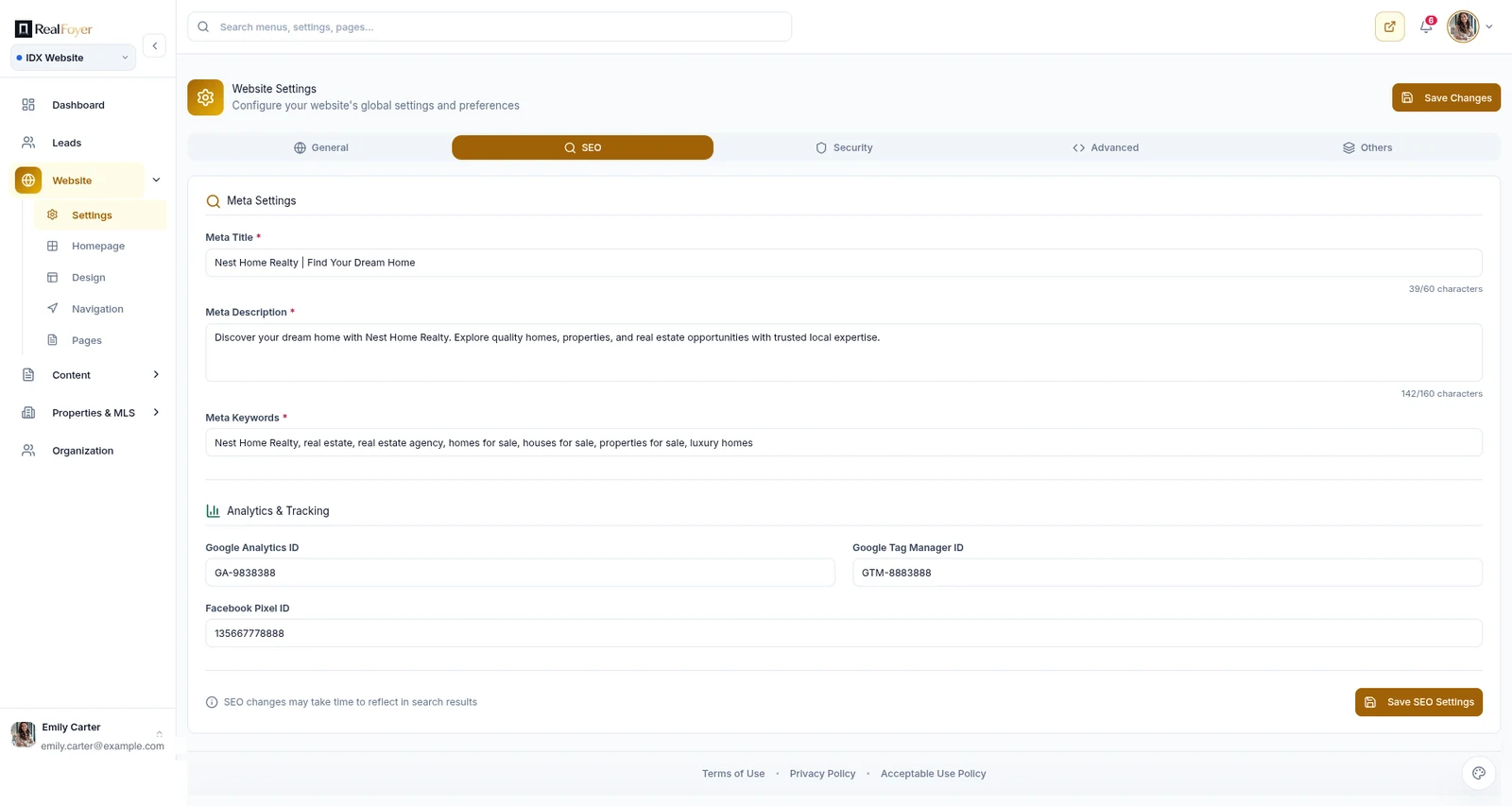
Google Business Profile
Claim it, verify it, complete it. Right primary category, real photographs, every field filled, service areas limited to places you have actually worked.
This is the highest-leverage item in the whole ninety days and it takes an afternoon. Local SEO covers it properly.
Canonical business information
Write down one exact format for your name, brokerage, address and phone. Then fix the three highest-traffic places that disagree with it.
Finite work with a definite end, which makes it unusually satisfying SEO.
Analytics and Search Console
Install both, verify both, submit your sitemap. Search Console is the only place you find out what Google actually thinks of your site, and it only retains data from verification onward — every week you delay is a week you cannot look back at.
The crawl check
Four things, in order of how often they are the problem:
- An accidental
noindex. Usually left over from staging. It is the single most common cause of a site that inexplicably does not rank. robots.txt. Confirm you are not blocking your own listing or area directories.- Sitemap. Exists, submitted, contains the pages you want indexed and not the ones you don't.
- Filter URLs. IDX sites generate enormous numbers of near-identical filter combinations. Left uncanonicalised they consume crawl budget and compete with each other. Technical SEO covers the mechanics.
A real contact page
Full business details in text, matching your canonical format. Not baked into an image, not only in a form.
End of month one you should have: a verified profile, a verified Search Console, a crawlable site, and a written record of your business details. No new content. That is correct.
Days 31–60 — location content
The aim: publish the pages only you can write.
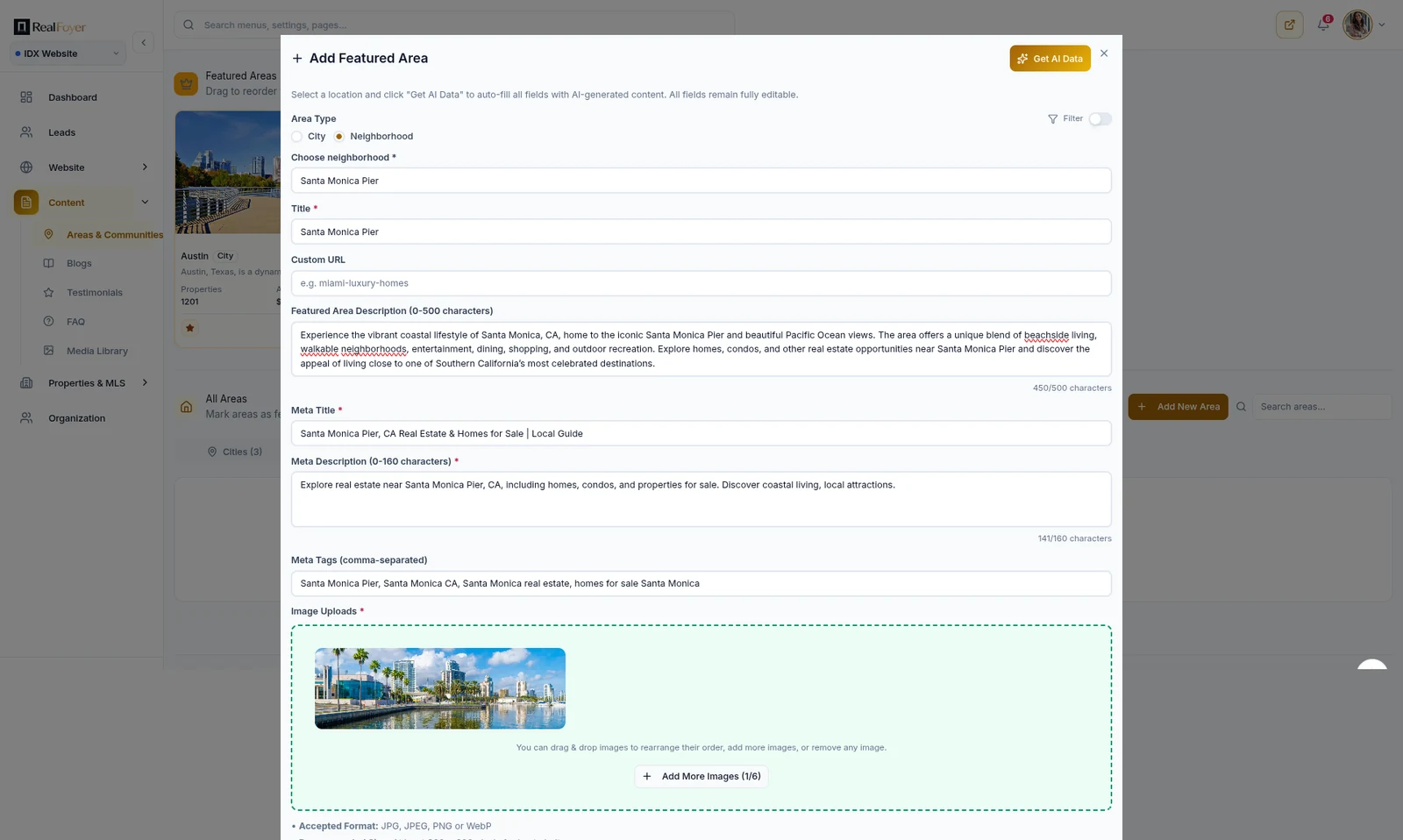
Two or three area pages
Not ten. Pick the areas you know best — the ones you could talk about for twenty minutes without preparation — and write those properly.
Each needs real boundaries (not postcodes), presence detail nobody else has, current inventory for that actual area, and any market figure carrying a source and a date. Neighbourhood pages is the full treatment.
The test before publishing: remove the place name. Could this be about anywhere else? If yes, it is not ready.
One city or market page above them
The level above your areas, doing a different job: market-wide context, and the hub that links down. City and market pages covers the distinction, which matters — a city page written like a big neighbourhood page competes with its own children.
The internal links
Easy to skip and the reason area pages go undiscovered.
City page links down to every area page. Every area page links back up, ideally through breadcrumbs. Adjacent areas link sideways, contextually, in a sentence.
Not a footer block of forty links on every page.
Review requests
Ask your last five clients. Direct link, specific request — "would you mention which neighbourhood we looked in?"
Slow-burning, which is exactly why it belongs early.
End of month two: three or four real pages, linked properly, and a few new reviews. It will feel like very little. It is more durable than fifty generated pages.
Days 61–90 — extend and measure
The aim: find out what is actually happening before scaling anything.
Read Search Console properly
Not the headline number. The queries.
Which queries are you appearing for? Often not the ones you targeted, and the surprises are the opportunity — a query you are on page two for with no dedicated page is the easiest win available.
Which pages get impressions? If an area page has none after a month, that is information: either it is not indexed, or nobody searches that way.
Impressions without clicks? You are surfacing and not being chosen. Usually a title and description problem, which is a same-day fix.
Two or three more area pages — chosen from data
Now you extend. The difference from month two is that the choice comes from what Search Console shows rather than from a list you wrote in week one.
Consolidate what is thin
By now you will have found pages from before this exercise that are thin, duplicated or generated. Consolidate or remove them.
Counter-intuitive and worth doing: a large volume of weak pages can affect how the rest of the site is assessed. Fewer, better pages is not a compromise.
Write down a cadence you can keep
Monthly is fine. Quarterly is fine. What is not fine is a schedule that assumes a version of you with more time.
Specifically: refresh dated figures on a schedule, revisit a page properly when something changes in the area, and add pages when you have something to say — not when a calendar says to.
Record the baseline
Impressions, clicks, indexed pages, enquiries from organic, review count. Five numbers, in a file, dated. Month four's numbers are meaningless without them.
What 90 days does not buy you
Being direct about this, because it is where the disappointment comes from.
Not rankings on a schedule. Competitive area terms can take many months. Some never come. The variance is enormous and nobody can price it in advance.
Not traffic by a particular month. Anyone who tells you what month three looks like is describing someone else's site.
Not a finished job. Ninety days gets you a foundation that works and a handful of pages that are genuinely good. That is the platform, not the outcome.
What it does buy: a site that can rank, pages that deserve to, a business a search engine can identify, and — most valuable — measurement that tells you what to do next. Most agents never get to that point, not because it is hard but because they start with content on a broken foundation and lose faith by month four.
Day 91 onward
Repeat the third phase indefinitely. Look at the data, extend what works, fix what doesn't, maintain what you have.
The trap after ninety days is scaling before the data supports it — publishing thirty area pages because three worked. Three worked because you knew those areas. The fourth-best area you know is still worth a page; the twenty-fifth is not.
FAQ
Can I compress this into 30 days? The foundation, yes. The content, no — not without writing pages you do not know enough to write.
What if I already have a site with lots of pages? Do phase one unchanged, then spend phase two auditing rather than publishing. Existing thin pages are usually a bigger opportunity than new ones.
Do I need a specialist? For the technical items in phase one, possibly, and it is a few hours of work. Phase two you cannot outsource — the value is what you know about the area.
What if I don't have listings yet? Area and market content still works, and the pages will be stronger later when inventory appears beneath them.
How much should this cost? Mostly time. The paid items are hosting and possibly a few hours of technical help. Be sceptical of a retainer that starts before phase one is finished.
When should I expect results? No honest answer exists. Watch Search Console impressions as the leading indicator — they move before rankings do, and before traffic does.
In short
Foundation first, because content on an uncrawlable site is invisible. Then a small number of pages only you could write, linked properly. Then measurement, and extension chosen by data rather than by ambition.
Ninety days will not deliver rankings on a schedule, and anyone promising otherwise is guessing. It will deliver a site that can rank, a handful of pages that deserve to, and the measurement that tells you where to go next.
Explore RealFoyer IDX websites — the phase-one items around crawlability, area pages and listing inventory are platform-dependent.
Related reading
- Real Estate SEO: The Complete Guide
- Technical SEO for Real Estate Websites
- Local SEO for Real Estate Agents
- Neighborhood Pages That Actually Rank
- Real Estate City & Market Pages
Research Integrity
Published 16 August 2026. This is an implementation plan and makes no claim about when rankings, traffic or enquiries arrive; a dedicated section states what ninety days does not buy, and the diagram carries the same caveat so it cannot be lifted out of context as a results timeline. No industry timelines or traffic benchmarks are cited, because the figures in circulation are vendor estimates without traceable sources. The observation that Search Console retains data only from verification onward is a property of the tool, and is the reason verification is placed in week one. Content consolidated here previously sat inside the SEO pillar and the technical SEO article; both now link here rather than repeating it.