SEO
AEO for Real Estate: How to Get Found in AI Search
What AEO asks of real estate content: clear answers, entity clarity, crawlable pages, first-hand local expertise, and which AI-search claims don’t hold up.
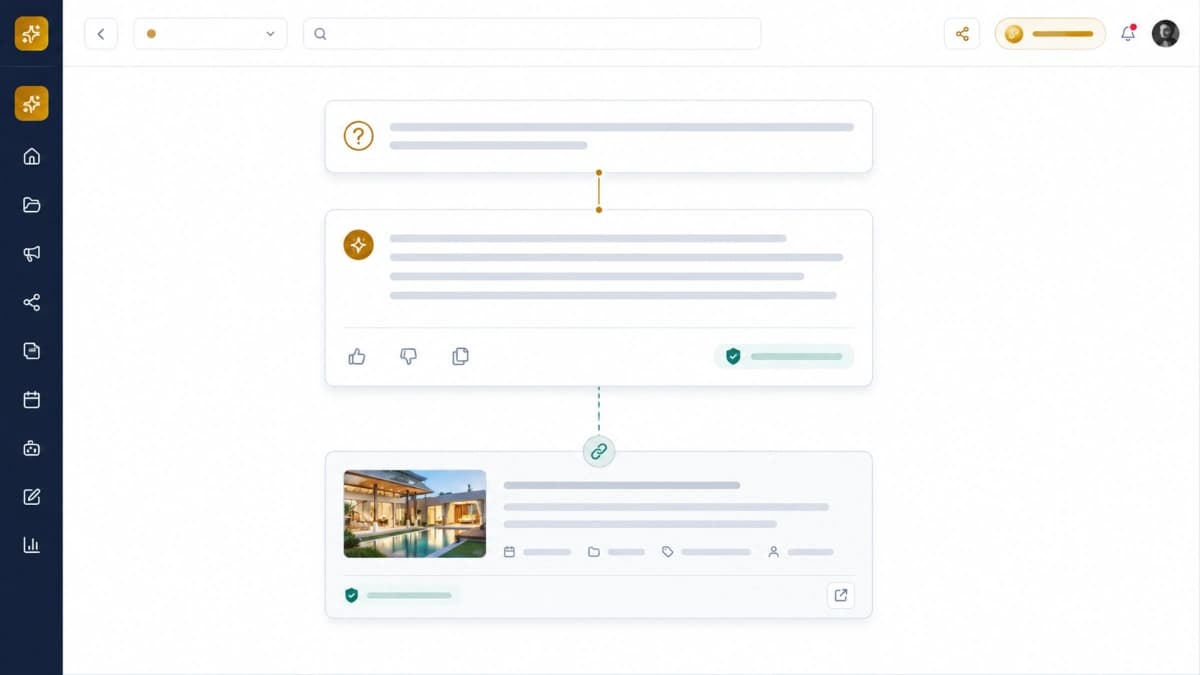
Introduction
People increasingly ask a question and get an answer rather than a list of links. Sometimes that answer cites sources; sometimes it doesn't. Either way it changes what "being found" means for a real estate business.
The response has been a rush of advice about optimising for AI search, much of it inventing mechanisms that do not exist. This article tries to be useful about a genuinely uncertain subject: what actually seems to matter, what is unknowable, and what is being sold to you.
⚡ Quick answer — how do you optimise for AI answers? Mostly by doing good SEO more precisely. Answer engines need content they can reach, parse and trust: a clear answer stated early, unambiguous facts about who and where you are, and information that is genuinely first-hand. There is no special markup, no submission process and no way to guarantee a citation. The largest real difference is that you may be the source rather than the destination — which changes what you measure more than what you write.
What AEO is, and isn't
Answer engine optimization is making content useful to systems that compose answers rather than rank links — AI overviews in search, chat assistants, and anything else synthesising a response.
It is not a replacement for SEO. The systems composing these answers largely draw on the same index, need the same crawlability, and reward much of the same quality. An agent who abandons SEO for AEO has abandoned the foundation that AEO sits on.
Ranked results
Classic search
A list of links the reader chooses between
Rewards
- Matching the query
- Being crawlable and indexable
- Depth on a page worth clicking
- Internal links and site structure
Clicks through, lands on your page
Synthesized answers
AI answers, assistants, overviews
A composed answer, sometimes citing sources
Rewards
- Stating the answer plainly, early
- Being extractable in a paragraph
- Clear entities — who, where, what
- Corroboration across sources
May never click. You are the source, not the destination
The shared foundation — most of the work
- Content a crawler can actually reach and render
- Accurate, specific, first-hand information
- A page that answers the question it appears to be about
- Consistency about who you are and where you work
- Something a competitor cannot copy from a database
Two surfaces, one foundation. Optimising for answers is mostly the same work as optimising for results, done more precisely — neither replaces the other.
The honest framing is two surfaces onto overlapping infrastructure. Some things help both. A few help one more than the other. Almost nothing helps one at the expense of the other.
Five claims that don't hold up
Worth clearing these first, because they are everywhere.
"There's a ChatGPT schema." There is not. No answer engine has published a proprietary structured-data vocabulary for you to implement. Schema.org markup is useful for reasons that predate all of this; nothing about it is AI-specific.
"You can guarantee citations." Nobody can. Which sources get cited varies by query, by model, by version, and often between two identical questions asked minutes apart. Any service promising placement in AI answers is selling something it cannot deliver.
"Traditional SEO is obsolete." The opposite is closer to true. Being crawlable, indexable and authoritative is a precondition for most of these systems, and the fastest way to disappear from AI answers is to become invisible to the index they draw on.
"There's one optimisation that gets you in." No single change does this. The mechanisms are opaque, they change, and they are not uniform across systems.
"You can track your AI ranking." There is no ranking. There is a composed answer that may or may not mention you, varying by phrasing and context. Tools claiming to measure your AI rank are measuring their own sampling.
If a tactic sounds like a trick, it is being sold to you.
What plausibly does help
Less certain than the section above — these are reasoned from how these systems work rather than from published mechanisms. Usefully, all of it is defensible even if AI search stalls entirely, because it is just good content practice.
Answer the question early and plainly
The most transferable habit. If a page is about how long a home sale takes in your market, the answer should appear in the first paragraph, in a complete sentence, in plain language.
A paragraph that stands alone — makes sense lifted out of context, without "as we discussed above" — is easier for a system to extract and easier for a person skimming. Both audiences reward the same structure.
This is why the Quick Answer blocks throughout this site exist. Not because a system requires them, but because a question with a direct answer near the top serves everyone.
Be clear about entities
Answer engines need to establish who and where with confidence.
Be unambiguous about your business name, your brokerage, the areas you work, your credentials and your jurisdiction. Say them in text, consistently, in places a machine will look — your about page, your contact page, your author information.
This overlaps almost entirely with local SEO, and the consistency work there pays here too.
Publish things only you know
The most durable advantage, and the one that survives every algorithm change.
A model composing an answer about a neighbourhood can synthesise the general from a thousand sources. What it cannot synthesise is what a specific street is like on a weekday morning, why the east side trades at a premium, or what happened to inventory when a building completed last spring.
First-hand local knowledge is the one thing that cannot be assembled from other sources — which makes it both the reason to cite you and the reason a reader clicks through.
Structure content so it can be parsed
Descriptive headings that state their subject. Short paragraphs. Tables where you are comparing things. Lists where order matters. Definitions phrased as definitions.
None of this is AI-specific. It is what makes a page scannable, and scannable pages happen to be extractable.
Use structured data where it genuinely applies
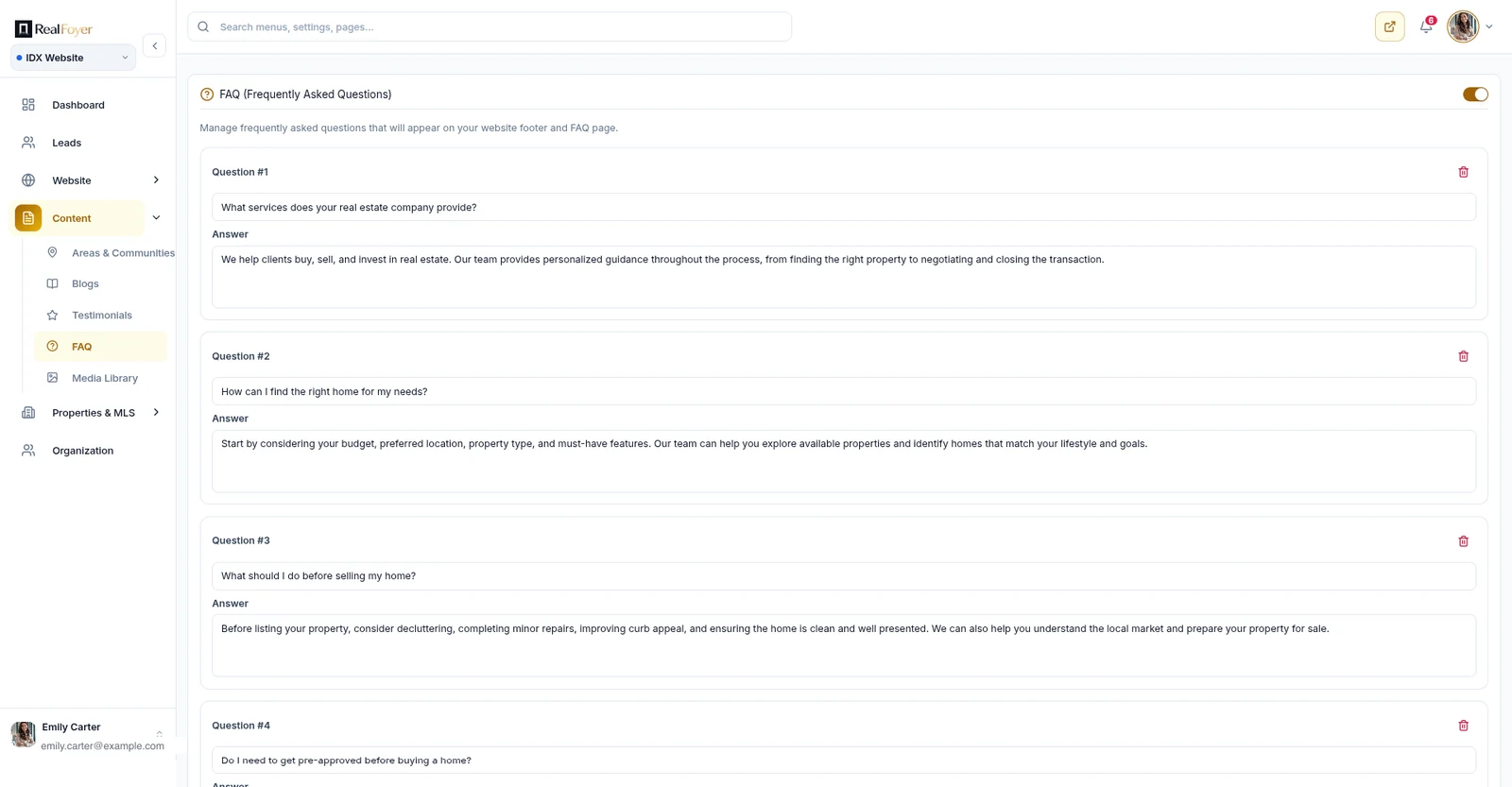
Organization on your about or contact page. BreadcrumbList for hierarchy. FAQPage where you have real questions and answers. RealEstateListing on listing pages where appropriate.
Structured data helps a machine understand what it is reading. It does not make thin content authoritative, and marking a page up as something it is not is worse than no markup.
Be consistent across sources
Corroboration appears to matter. If your credentials, areas and business details agree across your site, your profiles and any directory that lists you, you are easier to state confidently. If they disagree, you are a source of uncertainty.
Stay crawlable
The unglamorous precondition. Content behind a registration wall, rendered only by client-side JavaScript, or blocked in robots.txt is not available to be cited. Technical SEO covers the mechanics — all of it applies here unchanged.
What changes for a real estate business
Two things worth thinking about properly.
You may be the source rather than the destination. If an assistant answers "what's the average price in Oakville" using your market page, the reader may never visit. That is a real cost, and it is not fully avoidable.
The mitigation is not to withhold the answer — a page that refuses to answer gets neither the citation nor the click. It is to make the rest of the page worth arriving for. An answer plus genuinely local context gives the reader a reason to come to the source, and gives you something a summary cannot fully carry.
The question is the unit. People phrase things to assistants the way they would to a person — "is it a good time to sell in Burlington" rather than "burlington real estate market". Content organised around real questions people ask you is well positioned for that, and it was already the better way to write.
What to measure
Harder than conventional SEO, and worth being honest about the limits.
Referral traffic from AI surfaces. Some assistants pass identifiable referrers. It is partial, and it is real data rather than an estimate.
Branded search volume. If people encounter you in answers, some will later search your name. A rise in branded search without a matching rise in other channels is weak evidence of something happening upstream.
Direct enquiries mentioning it. Ask. "How did you find us?" occasionally produces "ChatGPT said…", and that is worth more than any tool's estimate.
Spot-check by asking. Ask a few assistants the questions your market cares about and see who gets cited. Anecdotal, unstable, and still informative about who is being drawn on.
What not to do: buy a tool that reports an "AI visibility score". There is no denominator behind that number.
The uncomfortable summary
Most AEO advice reduces to do the things that were already good practice, and be more disciplined about clarity. That is unsatisfying next to a tactic list, and it has the advantage of being true.
The genuinely new consideration is the shift from destination to source — and the response to that is to be worth visiting, not to be harder to summarise.
If you want one instruction: write the pages only you can write, answer the question at the top, and be unambiguous about who and where you are. That serves ranked results, synthesized answers, and the person who actually calls you.
FAQ
Do I need to do anything different from SEO? Mostly not. Answer clearly and early, be unambiguous about entities, keep content crawlable. The rest is the SEO you should already be doing.
Should I add FAQ schema to everything? Only where you have real questions and real answers. Marking up content that is not an FAQ is misrepresentation, and support for FAQ rich results has narrowed.
Will AI search kill real estate websites? Unknown, and anyone confident either way is guessing. What is clear is that generic content is most exposed — it is exactly what a model can already produce — and first-hand local content is least.
Should I block AI crawlers? A real decision with a real trade-off: blocking may protect content from being summarised without attribution, and it also removes you from answers entirely. For most agents, visibility is worth more.
Does listing data get cited? Sometimes, and your MLS agreement may constrain how listing data can be displayed and reused. That is worth checking before optimising for it — see IDX compliance.
How long until this matters? It already does, unevenly. The work is defensible regardless, which is the main argument for doing it now.
In short
Answer engines need content they can reach, parse and trust. That means saying the answer plainly and early, being unambiguous about who and where you are, keeping pages crawlable, and publishing what only presence can produce.
There is no special schema, no submission, and no guaranteed citation. The genuine shift is that you may be the source rather than the destination — and the answer to that is to be worth visiting, not to be harder to quote.
Explore RealFoyer IDX websites — crawlable area pages and real listing inventory are the substrate all of this runs on.
Related reading
- Real Estate SEO: The Complete Guide
- Technical SEO for Real Estate Websites
- Local SEO for Real Estate Agents
- Neighborhood Pages That Actually Rank
Research Integrity
Published 16 August 2026. This article deliberately separates what is known from what is inferred. The five debunked claims are stated as absences — no published proprietary schema, no submission process, no citation guarantee, no single optimisation, no measurable "AI ranking" — because no vendor documentation supports any of them. The section on what plausibly helps is explicitly labelled as reasoning from how these systems work rather than from published mechanisms, and every recommendation in it is defensible as ordinary content practice independent of AI search. No statistics about AI search adoption, traffic impact or citation rates are cited, because the figures in circulation are vendor estimates that do not survive checking. No RealFoyer AEO capability is claimed; the product connection is limited to crawlable pages and listing inventory.