IDX & MLS
MLS & IDX Compliance: What Your Real Estate Website Must Handle
Attribution, disclaimers, data refresh, media use and permitted purposes — the compliance layers an IDX website must account for, and why they differ by MLS.
Introduction
Compliance is the part of running an IDX website that nobody sells you on and every board takes seriously. It is also the part most often described wrongly, because the obligations are set locally and most guidance is written as though they were national.
They are not. Attribution wording, whether sold data may appear at all, how quickly a withdrawn listing must come down, what you may do with a photograph — these are set by your MLS, your board or association, and the data licence you signed. Two agents in neighbouring markets can both be fully compliant while running visibly different websites.
This article maps the layers you need to account for, and is explicit about which specifics you have to confirm locally.
⚡ Quick answer — What does IDX compliance involve? Displaying MLS listings under an IDX agreement generally means attributing listings to the listing brokerage, showing required disclaimers, keeping data current, using photos and data only as permitted, and restricting use to the purposes your licence allows. The exact requirements — wording, timing and what may be displayed — vary by MLS, board, association and data licence, and must be confirmed with your own MLS.
This is not legal advice. It is an orientation to the categories of obligation. Your MLS's rules and your data licence govern, and where something is unclear, ask them rather than a vendor.
Exact requirements vary by MLS, board, association and data licence.
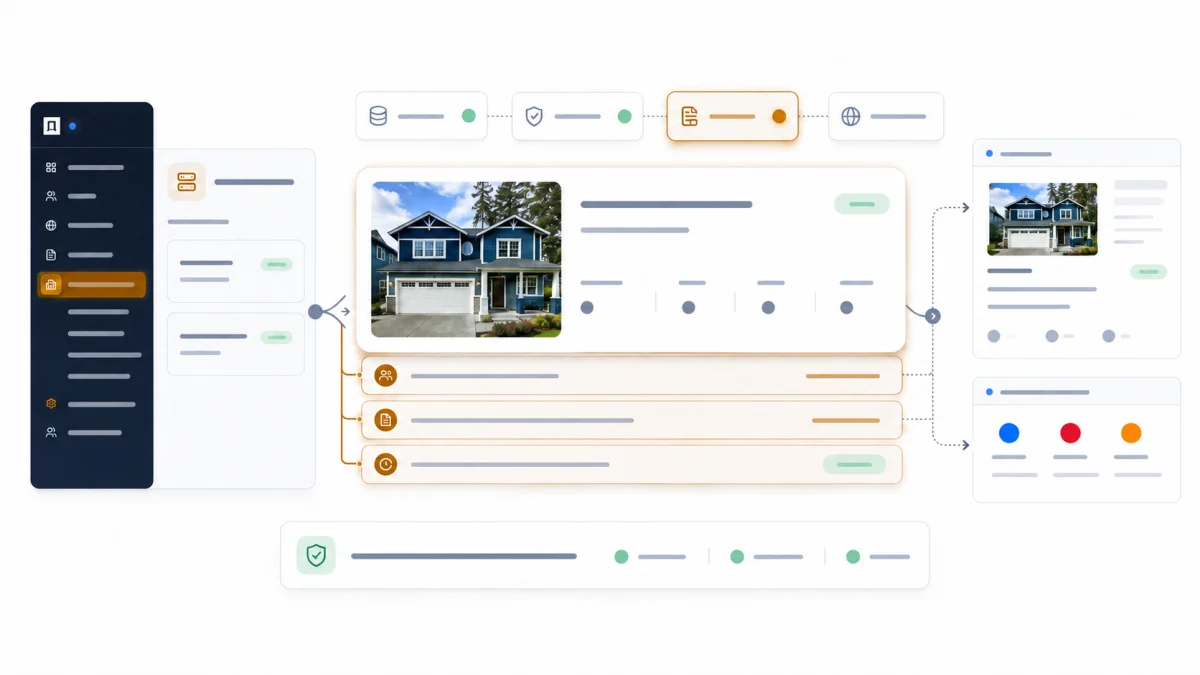
This map shows the layers you have to account for — not a universal rulebook. Confirm specifics with your own MLS.
Data licence & MLS rulesGoverns all of the below
The agreement that governs everything below it
Display authorization
Which listings you may show, and to whom
Attribution
Listing brokerage, and often the MLS and last-update time
Data freshness
How quickly changes and removals must be reflected
Media usage
How photos may be shown, stored and altered
Disclaimers
Required notices, and where they must appear
Access & usage rules
Registration, permitted uses, retention on exit
The licence governs everything else
Every obligation below descends from one document: the agreement you signed to receive the data.
That agreement defines which feed you receive, what you may display, to whom, for what purpose and for how long. It is worth actually reading — not because the categories are surprising, but because the specifics inside them are the answer to almost every compliance question you will have later.
If you cannot find your copy, your MLS can. Vendors often cannot; they are not party to it.
Display authorization
The first question is which listings you are permitted to show.
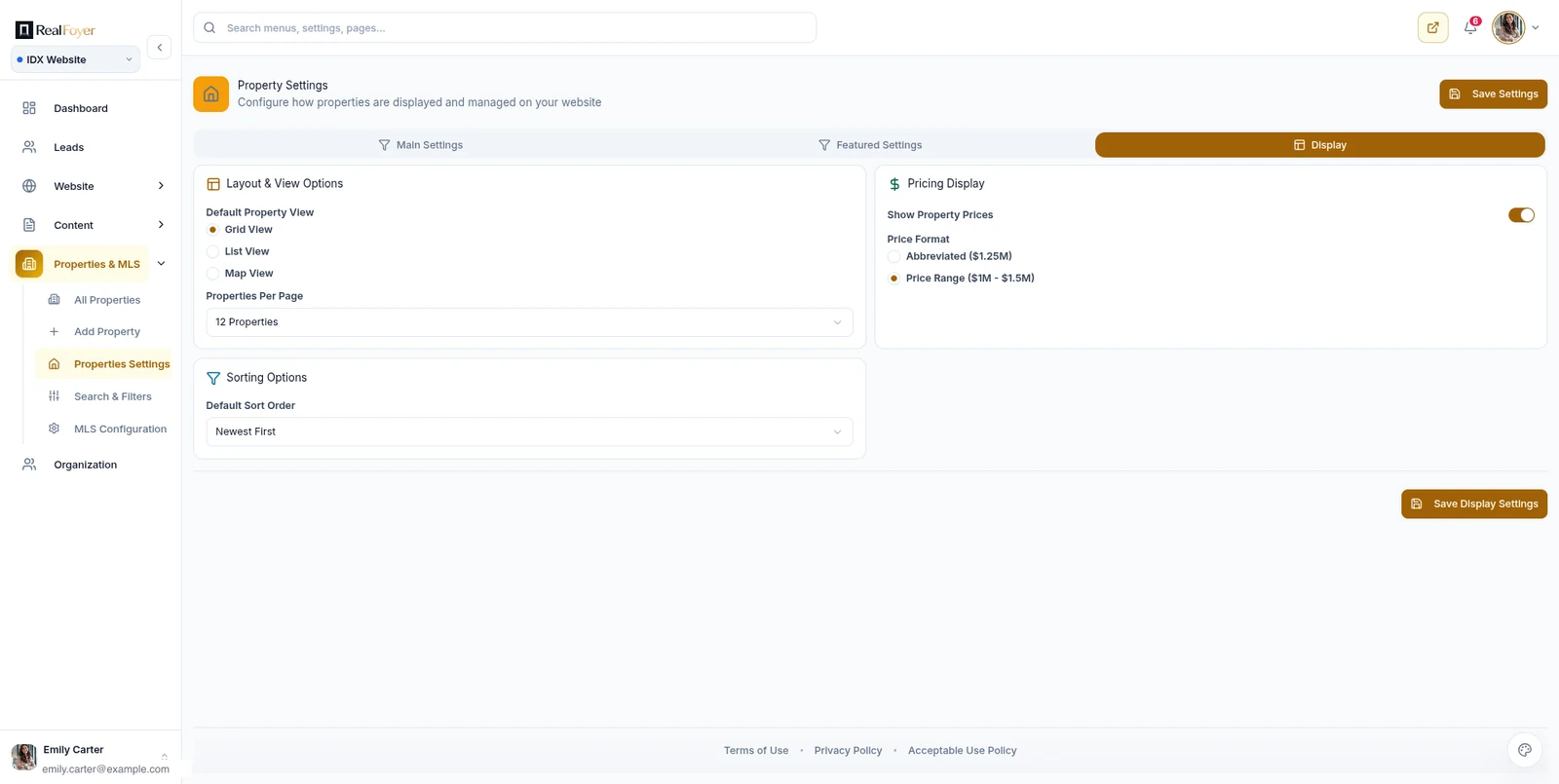
Under IDX, participating brokerages consent to their listings being displayed by other participants. That consent is not always universal — some MLSs allow sellers to opt out of internet display, and those listings must be excluded. A compliant site respects those flags automatically rather than relying on anyone to notice.
Access model matters here too. IDX is public display. A VOW shows a broader set behind registration and a broker-consumer relationship, where the MLS permits one at all. Whether you can operate a VOW, and what extra data it unlocks, is a local question.
Attribution
Attribution is the most visible requirement and the one most commonly done partially.
Broadly, a listing that is not yours must be attributed to the brokerage that holds it. Many MLSs additionally require the MLS itself be identified, sometimes with a logo, and some require a last-updated timestamp so consumers can judge freshness.
The variation is in the detail: exact wording, whether the listing agent must be named as well as the brokerage, placement, and whether attribution must appear on search result cards or only on the detail page. These differ enough between boards that copying another agent's site is a genuinely bad strategy — you may be copying a different board's rules.
Disclaimers
Most MLSs require notices stating that data comes from the MLS, is deemed reliable but not guaranteed, and should be independently verified. Some require additional notices about the nature of IDX display.
Two practical points. Required text usually has to be visible rather than buried in a footer link, and it generally has to appear wherever listing data appears — including search results, not only detail pages.
Data freshness
Boards set expectations for how current displayed data must be, and for how quickly listings that are sold, withdrawn or expired come down.
This is where a compliance obligation and a technical one meet. Meeting a refresh expectation is not a policy decision; it depends on whether your platform's synchronization is actually running and whether anything detects a failed run. A site can be perfectly configured and still fall out of compliance because a sync stopped three weeks ago and nobody was told.
Read next: MLS Integration: How Listing Data Actually Reaches Your Website covers how updates propagate and where staleness enters.
Permitted fields, and sold data
Not every field in the MLS may be displayed publicly. Feeds are usually scoped so that restricted fields — showing instructions, seller contact details, compensation terms — never arrive at your site at all. Where they do arrive, it does not follow that you may show them.
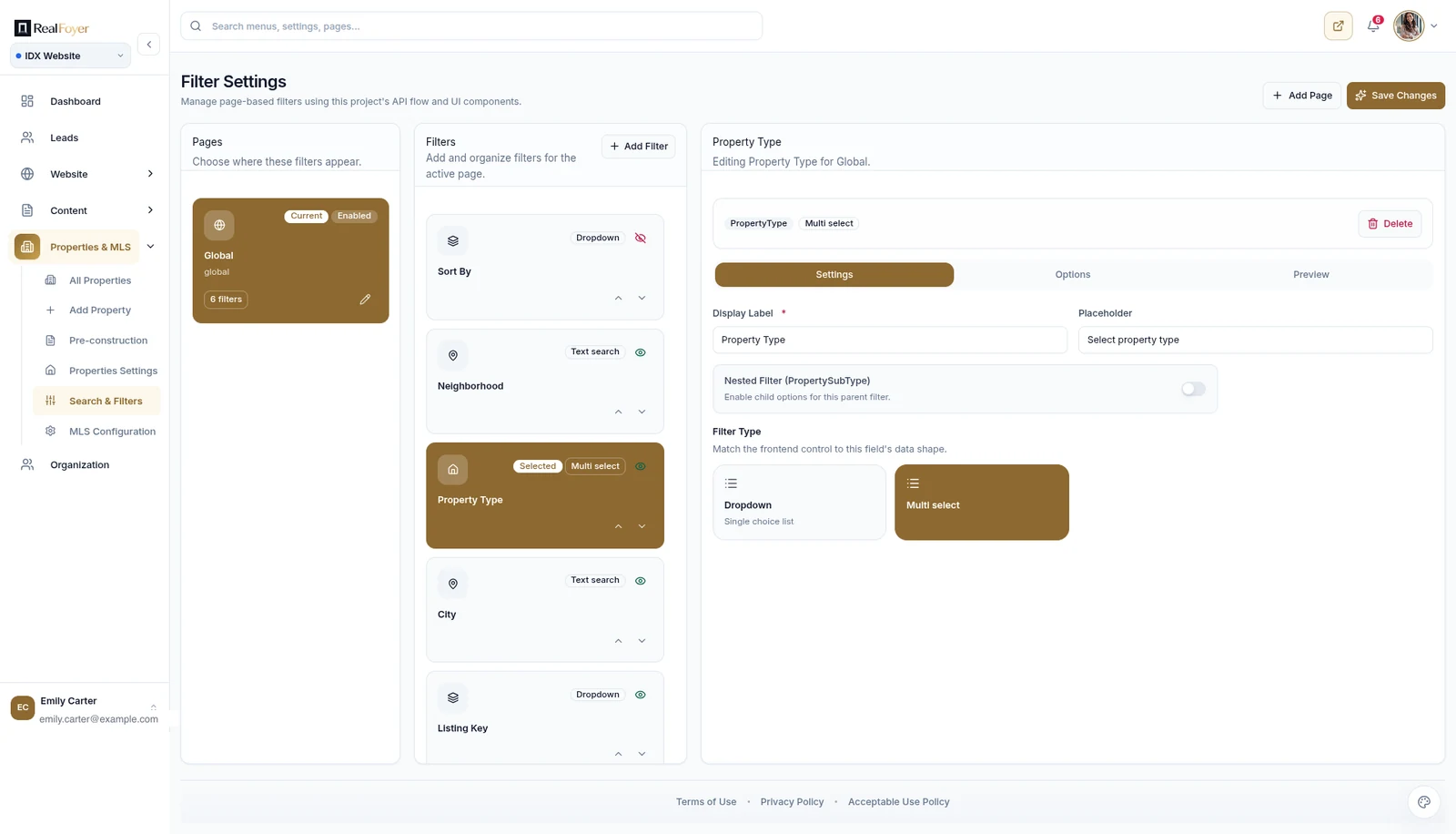
Sold and off-market data is the most common question and has no national answer. Some MLSs permit sold data on IDX displays. Some permit it only behind VOW registration. Some do not permit it at all. If sold history matters to your strategy, establish what your board allows before building around it.
Media
Photographs are licensed, not given. The listing brokerage or photographer typically holds copyright, and your right to display images comes from the same agreement as the data.
Common constraints include restrictions on modifying images, on removing or adding watermarks, on using listing photos in advertising outside the site, and on retaining images after a listing leaves the feed. Cropping and resizing for display is normally fine; treating another brokerage's listing photo as marketing material for yourself usually is not.
Modifying listing data
You may generally present data — layout, typography, ordering — but not alter its substance. Changing a price, editing remarks or correcting what you believe is an error in another brokerage's listing is not yours to do. Report it to the MLS.
Adding your own content alongside a listing is normally acceptable and is the basis of most useful area pages. The line is between adding context around the record and changing the record.
Registration and permitted use
Whether you may require registration before showing listings, and at what point, varies. Some MLSs prohibit gating IDX results entirely; others permit it; VOW models require it by definition.
Permitted use also constrains what you do with the data behind the scenes — scraping, redistributing to third parties, feeding it into unrelated products, or retaining it after your agreement ends. Retention on exit is worth settling early: what happens to the listing data, and to the contact records you built, if you leave the platform or change brokerages.
Why this varies so much, and what to do about it
There is no single national IDX rulebook. National-level policy frameworks exist, but MLSs, boards and associations implement locally, and your data licence is the operative document.
Three practical habits:
- Get the rules in writing from your MLS rather than from a vendor or another agent's site.
- Ask vendors how differences are handled per board, not whether they are "IDX compliant" — a claim that means little without naming a board.
- Re-check after changes. Rules are updated, and a site configured correctly two years ago may not be today.
Handling this variation is a real part of what an IDX platform does — the gap between one feed and the display rules of the board it came from is where the work sits. See RealFoyer IDX websites for how that is approached.
FAQ
Is there one IDX compliance standard across the US and Canada? No. Requirements are set by individual MLSs, boards and associations, and by your data licence. Expect differences between markets.
Who is responsible if my website is non-compliant — me or my vendor? Your agreement is with the MLS, so the obligation is generally yours. Your vendor's contract may allocate responsibility between you, but that is separate from your obligation to the board.
Can I display sold listings? It depends on your MLS. Some allow it on IDX, some only under VOW, some not at all. Confirm before building it into your plans.
Do I need attribution on search results, or only on the listing page? That varies by MLS. Several require it in both places. Check your rules rather than assuming the detail page is enough.
Can I use listing photos in my social media marketing? For your own listings, generally yes. For another brokerage's listings, usually not without permission — the images are licensed for display, not for your advertising.
What happens to the data if I leave my platform? Your feed follows your MLS membership. What happens to cached data, images and contact records depends on your platform agreement — agree it in writing before signing.
In short
IDX compliance is a stack: a data licence at the bottom, and above it display authorization, attribution, disclaimers, freshness, media use and permitted purposes. The categories are consistent; the specifics are local.
The single most useful thing you can do is get your own MLS's current rules in writing and check your site against them — including whether your data is actually refreshing.
See which boards are supported on the MLS coverage page.
Related reading
- Real Estate IDX Websites: The Complete Guide
- MLS Integration: How Listing Data Actually Reaches Your Website
- RETS vs RESO Web API: What Real Estate Professionals Should Know
Research Integrity
Written 16 August 2026. This article deliberately contains no universal requirement claims and no jurisdiction-specific rule text, because IDX obligations are set by individual MLSs, boards and data licences rather than by one national standard. Where the previous IDX guide stated specific requirements as though they applied everywhere, those have been reframed as categories to confirm locally. Nothing here is legal advice.