AI
AI Content & Fair Housing: What Agents Need to Review Before Publishing
A five-check review for AI-drafted real estate marketing — facts, fair housing, location claims, brand voice, approval — with phrasings that create exposure.
Introduction
The risk with AI-drafted marketing is not that it produces something obviously offensive. It is that it produces something that reads perfectly well, sounds like every listing you have ever seen, and contains a phrase that a fair housing tester would flag immediately.
Those phrases are common in AI output for a straightforward reason: they are common in the training data. Decades of real estate copy contains "perfect for young families" and "quiet, safe neighbourhood", so a model reproduces them fluently and without hesitation.
This article is a review process for catching that before it publishes. It is educational, not legal advice — requirements vary by jurisdiction, and if you publish marketing at volume, have someone qualified review your templates once.
⚡ Quick answer — what should I check before publishing AI-drafted copy? Five things, in order. Facts — is every property statement true? Fair housing — does the copy describe the property, or the people who should live in it? Location — are neighbourhood, school and safety claims defensible? Brand voice — does it sound like you? Approval — would you knowingly publish this under your own licence? The second is the one with legal consequences and the one AI gets wrong most reliably.
What the law actually says
Worth being specific, because this area attracts a lot of vague warnings.
In the United States, the Fair Housing Act at 42 U.S.C. §3604(c) — implemented at 24 CFR §100.75 — makes it unlawful to make, print or publish any notice, statement or advertisement about the sale or rental of a dwelling that indicates any preference, limitation or discrimination based on race, colour, religion, sex, handicap, familial status or national origin, or an intention to make one.
Two features of that provision matter for AI-drafted copy:
It covers the statement itself. You do not have to refuse anyone anything. Publishing the wording is the violation.
"Indicates a preference" is broader than stating one. Copy that signals who is welcome, without naming a protected class, is squarely within scope. That is precisely the register AI writes in.
In Canada, this is provincial. Ontario's Human Rights Code prohibits discrimination in housing on grounds including race, ancestry, place of origin, colour, ethnic origin, citizenship, creed, sex, sexual orientation, age, marital status, family status, disability and receipt of public assistance — a broader list than the US federal one. Section 13 of the Code separately prohibits publishing or displaying any notice, sign, symbol or representation indicating an intention to discriminate.
The Ontario Human Rights Commission gives concrete examples of advertising language that has been treated as problematic: "suits a working person", "adult lifestyle", "quiet building", "geared to young professionals", "professionals only", "not suitable for children". Note how ordinary those sound. That is the point.
Other provinces have their own codes with their own grounds. Check yours.
The five-check review
AI draft
Listing copy · flyer text · social caption · area insight
Human review
A person reads it. Nothing in the product does any of this for you.
- 1
Facts
Is every property statement correct?
Watch for — Invented square footage, features the home does not have, wrong year built
- 2
Fair housing
Does the copy describe the property, or the people who should live in it?
Watch for — Protected-class references, coded preferences, “perfect for” framing
- 3
Location
Are neighbourhood, school and safety claims defensible?
Watch for — School quality as a proxy, crime or safety characterisations, demographic description
- 4
Brand voice
Does it sound like you?
Watch for — Superlatives you would never use, generic filler, the wrong register for your market
- 5
Approval
Would you knowingly publish this under your own name and licence?
Watch for — If the answer needs a pause, the answer is no
Edit
Reject
Approve
Only an approved draft is published
Every step in the gate is human. RealFoyer generates drafts and does not check them for fair housing or advertising compliance — no software here certifies anything as compliant.
1. Facts — is every property statement correct?
The most common failure and the least discussed.
A model asked to describe a home supplies plausible detail: square footage, a year built, a finished basement, hardwood under the carpet. Some of it will be right. The wrong parts are unremarkable, which is exactly why they survive review.
Check against the listing record, line by line. Every number, every feature, every material.
Watch for: invented square footage · features the home does not have · wrong year built · a parking arrangement nobody confirmed · "recently renovated" attached to nothing.
The fix is upstream: give the model the fact block rather than asking it for facts. The AI marketing article covers that habit.
2. Fair housing — property, or people?
One question resolves most of this: does the sentence describe the home, or the person who should live in it?
Describing the home is always safe. Describing the intended resident is where exposure starts.
| Instead of | Write |
|---|---|
| "Perfect for a young family" | "Three bedrooms and a fenced garden" |
| "Ideal for professionals" | "Twelve minutes to the station" |
| "Great for empty nesters" | "Single-floor layout, no interior stairs" |
| "A quiet, family-friendly street" | "A residential street of semi-detached homes" |
| "Walking distance to churches" | "Walking distance to the high street" |
| "Bachelor pad" | "One bedroom, open-plan living area" |
| "Master bedroom" | "Primary bedroom" |
Coded preferences are the harder category, because none of these names a protected class:
- "Safe" and "good area" — routinely read as proxies for the demographics of a neighbourhood.
- "Family-friendly" and "adult" — familial status.
- "Traditional neighbourhood", "established community" — depending on context, proxies for race or national origin.
- "Exclusive", "private" — read carefully in a housing context.
- Anything about who the current residents are. Describing the population is the clearest version of the error.
Steering is the same problem in conversation rather than copy: directing buyers toward or away from areas based on a protected characteristic. AI-drafted follow-up that suggests "areas that would suit you" is worth reading with this specifically in mind.
Accessibility language cuts both ways. Describing accessible features factually is useful and correct. Framing them as being for a particular kind of person is not — "step-free entrance" rather than "great for elderly buyers".
3. Location — is this claim defensible?
The area paragraph is where AI invention and fair housing risk overlap most.
Schools. Legitimately useful information and legitimately expected. Presented as a quality ranking that implies who should live somewhere, it becomes something else — school quality is one of the most established proxies in this area. Name the school, cite the source, date the information, and let readers draw conclusions. Do not let a model write "excellent schools" unsourced.
Crime and safety. The clearest thing to avoid. "Safe neighbourhood" is unsupported, difficult to defend, and widely treated as a demographic proxy. Say nothing about crime. If a client asks, point them at the police service's own published data rather than characterising it yourself.
Demographics. Never describe who lives somewhere. Not "a diverse community", not "an established Italian neighbourhood", not "a young area". Even framed positively, it is a description of the population rather than the place.
Invented local facts. Models produce confident specifics about transit, development and amenities that are out of date or simply wrong. Anything a model tells you about a place needs checking, and most of it is not worth publishing anyway — neighbourhood pages work because of what you know from being there, which is exactly the part AI cannot supply.
4. Brand voice — does it sound like you?
Not a compliance check, and it belongs here because it is the one people actually do.
Superlatives you would not use. "Stunning", "must see", "won't last".
Overstatement. "Newly renovated" for a repainted room is a factual problem wearing a stylistic hat.
Register mismatch. Luxury phrasing on a starter home reads as insincere.
Read it aloud. If you would not say it to a client, do not publish it.
5. Approval — would you publish this knowingly?
The final gate, and it is deliberately a question about you rather than about the text.
Marketing published under your name and licence is your responsibility regardless of what drafted it. "The AI wrote it" is not a defence anywhere.
If a sentence makes you pause, cut it. The cost of removing it is nothing; the cost of defending it is not.
Other risks in AI-drafted marketing
Beyond fair housing.
Client and private information. A model given a full CRM record to draft from may reproduce details from it. Never put client information into a draft that will be published, and be deliberate about what you paste into any tool.
Discriminatory ad targeting. A separate exposure from copy. Housing advertising on the major platforms is subject to restricted targeting categories precisely because of past enforcement. If you run paid ads, the audience settings carry their own risk — and this is a good reason to be careful, since organic publishing does not implicate it.
Property imagery. AI-altered or AI-generated images of a home are a different problem from copy. Virtual staging is generally expected to be disclosed; presenting a generated image as a photograph of the property is misrepresentation.
Copied content. Models can reproduce text closely resembling their training data. For listing copy this is low risk; for longer marketing content it is worth a check.
MLS rules. Your board has its own requirements about what listing remarks may contain — contact information, open-house details, external links. These are independent of fair housing and vary by board. See IDX compliance.
Where RealFoyer sits in this
Stated plainly, because this is exactly the article where a vague product line would be a problem.
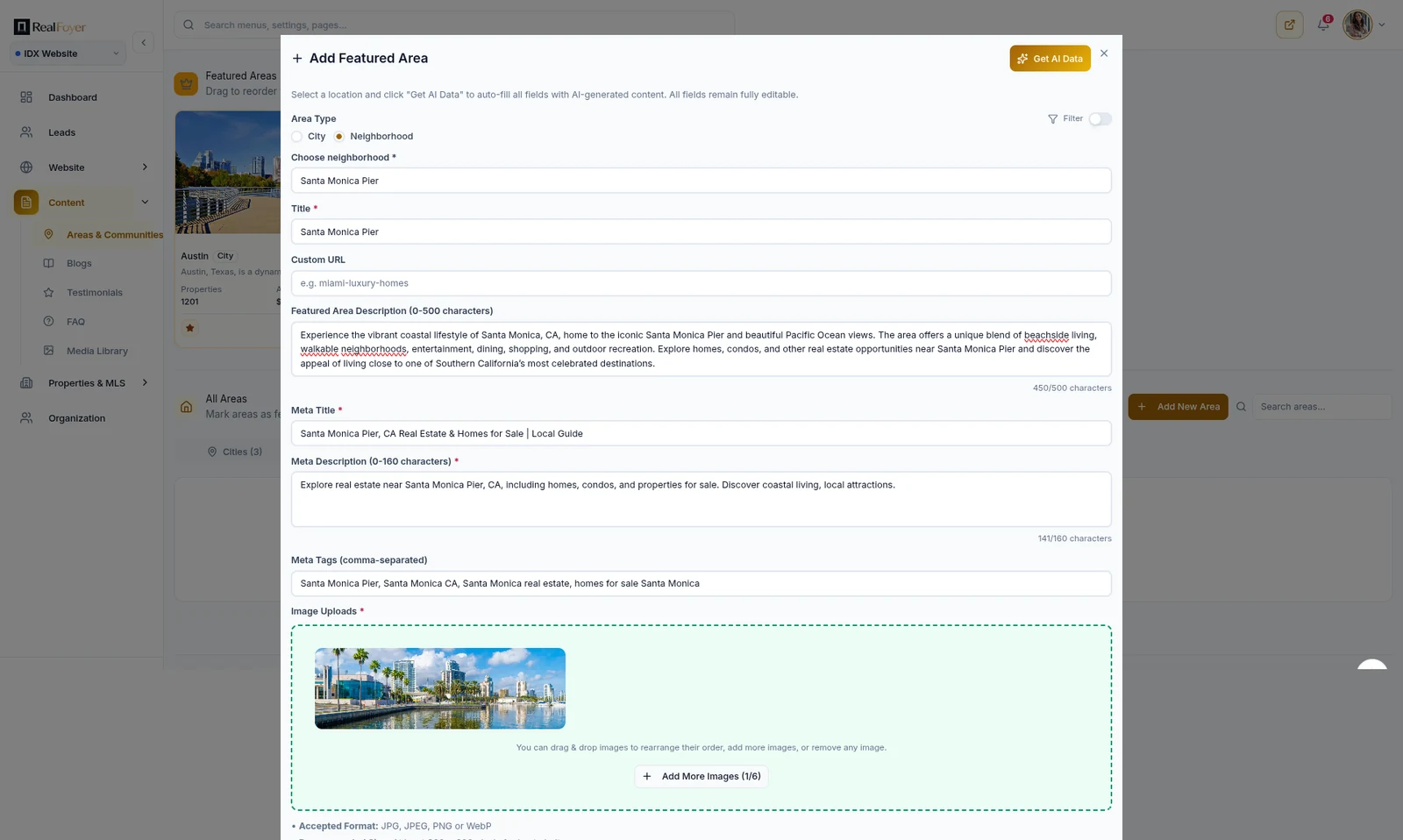
RealFoyer can generate public-facing marketing drafts — listing copy and public remarks, flyer headlines, descriptions and captions, social captions per platform, and area insight content.
RealFoyer does not check any of it for fair housing or advertising compliance. There is no automated review, no protected-class detection, no moderation step and no approval workflow on any generation path. No output is certified as compliant, and nothing in the product would prevent a draft containing the phrases above from publishing.
That is not a gap being apologised for; it is the accurate description, and it is why the five checks are yours to run. Any platform in this category claiming to check compliance for you is worth interrogating carefully before you rely on it.
A practical setup
Write the exclusions into your prompt. "Describe only the property. Do not describe who would enjoy living here. Do not mention schools, safety or the neighbourhood's character." Prevention beats review.
Keep a template you have had reviewed. If you publish at volume, one review of your standard prompt and structure by someone qualified is worth more than reviewing each draft harder.
Keep the drafts. If a complaint arrives, being able to show what was generated, what you changed and when is materially better than reconstructing it.
Review the same way every time. Five checks in the same order. Consistency catches more than intensity.
FAQ
Is AI-generated real estate copy legal? Yes. Nothing prohibits AI-drafted marketing. The published content is subject to the same rules as anything else you publish, and responsibility sits with you.
Does "perfect for families" really matter? Familial status is a protected class federally in the US, and family status is a prohibited ground across Canadian provincial codes. Language indicating a preference is squarely what §3604(c) and Ontario's s.13 address.
Can I say a neighbourhood is safe? Better not to. It is unsupported, hard to defend, and commonly treated as a demographic proxy. Point to the police service's published data if asked.
What about schools? Name them, cite the source, date it. Avoid quality rankings that imply who should live somewhere.
Who is liable if AI writes something discriminatory? You are, as the publisher. No jurisdiction recognises the tool as a defence.
Should I tell clients AI drafted the copy? No general disclosure requirement exists for marketing copy, though your board or brokerage may have a policy. AI-generated imagery is a different question with real disclosure expectations.
Does any platform check this automatically? Not RealFoyer, and be sceptical of anything claiming otherwise. Fair housing analysis is contextual, and a claim of automatic compliance approval is a large claim.
In short
AI reproduces the phrases that decades of real estate copy taught it, and some of those phrases are exactly the ones that create fair housing exposure. It does this fluently and without any signal that something is wrong.
Five checks before anything publishes: facts, fair housing, location, brand voice, approval. The single question that resolves most of it is whether the sentence describes the property or the person who should live in it.
Nothing checks this for you. That is not a limitation of one product — it is the current state of the category, and the review step is the part of the workflow that is not optional.
Explore RealFoyer AI drafting tools — drafts for listing copy, flyers and captions, with you reviewing every one before it goes out.
Related reading
- AI Marketing for Real Estate: What Actually Works
- Neighborhood Pages That Actually Rank
- MLS & IDX Compliance: What Your Real Estate Website Must Handle
- Real Estate CRM: How Agents, Teams and Brokerages Should Actually Use One
Research Integrity
Published 17 August 2026. US statutory content is drawn from the Fair Housing Act at 42 U.S.C. §3604(c) and its implementing regulation at 24 CFR §100.75, which prohibit notices, statements and advertisements indicating a preference, limitation or discrimination based on race, colour, religion, sex, handicap, familial status or national origin — the seven federal protected characteristics are quoted as the regulation lists them. Canadian content is drawn from the Ontario Human Rights Code, including its prohibited grounds in housing and the section 13 prohibition on publishing a notice, sign, symbol or representation indicating an intention to discriminate; the specific advertising phrases cited as problematic — "suits a working person", "adult lifestyle", "quiet building", "geared to young professionals", "professionals only", "not suitable for children" — come from Ontario Human Rights Commission guidance rather than from secondary commentary. The article states that other provinces have their own codes and grounds rather than generalising Ontario's. No enforcement statistics, penalty figures or case outcomes are cited. This is educational content and says so; readers publishing at volume are directed to have their templates reviewed by someone qualified. RealFoyer's position is stated as verified: the platform generates drafts and performs no fair housing or compliance check of any kind, a finding confirmed by searching both the CRM backend and the social publishing application for any approval, review or moderation gate and finding none.